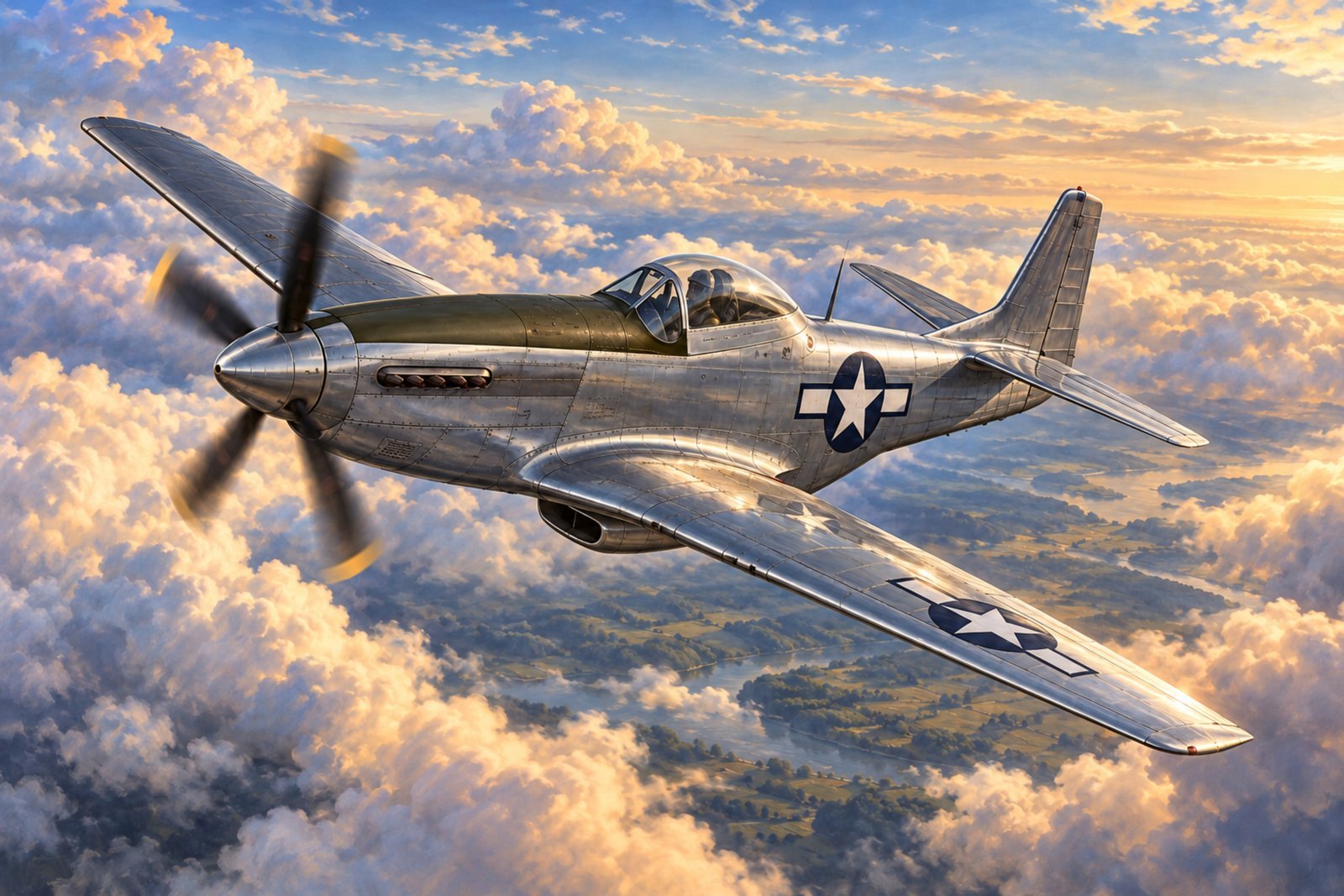
Eighty-six years ago this week, on 26 October 1940, a sleek prototype called the NA-73X lifted off from Mines Field in Los Angeles (the site of today’s LAX) with freelance test pilot Vance Breese at the controls. The first flight lasted about five minutes. Within four years its descendants were escorting American heavy bombers all the way to Berlin and back.
That aeroplane became the North American P-51, and it’s hard to find a WWII fighter with a bigger fan club. The Smithsonian’s National Air and Space Museum puts it plainly: “Many people consider the P-51 Mustang the best fighter of World War II.” It’s also the aeroplane behind our newest print, which you’ll find further down.
If you’ve read our posts on the golden age of biplanes and the Boeing-Stearman Kaydet, this is the next chapter. Plenty of the young pilots who learnt to fly in open-cockpit biplanes went on to fly this fighter in combat.
A British Order and a Blank Sheet of Paper
In 1940 Britain needed fighters, fast. British purchasing officials asked North American Aviation (NAA) to build Curtiss P-40s under licence. NAA had a better idea: let us design you a new and better fighter instead. The British agreed, and the NA-73X flew that October.
The British named it the Mustang I, and production began in 1941. Two early examples, designated XP-51, went to the US Army Air Forces (USAAF) for testing in the summer of 1941. The USAAF didn’t order it in quantity straight away, but General Henry “Hap” Arnold stepped in to keep 55 of the new fighters for American use, and most of those became F-6A photo-reconnaissance aircraft.
Part of the design’s secret was aerodynamic. NAA gave it a so-called laminar-flow wing, shaped to keep the airflow smooth over more of the wing and cut drag, with the radiator tucked into a neat scoop under the fuselage.
The Allison Years
The early versions used the American Allison V-1710 engine. Down low the aeroplane was fast and pleasant to fly, but the Allison ran out of breath at high altitude, which is exactly where the air war over Europe was being fought. The RAF used its early aircraft for low-level reconnaissance and ground attack. The USAAF’s P-51A went largely to the China-Burma-India theatre, and a dive-bomber version, the A-36 Apache, went into action in June 1943.
The Merlin Makeover
The breakthrough came in the autumn of 1942, when engineers in both Britain and the US experimentally fitted the Rolls-Royce Merlin, the engine of the Spitfire and Lancaster. It transformed the aircraft. One Merlin-powered test aircraft reached 441 mph (710 km/h) at 29,800 ft (9,080 m), about 100 mph (160 km/h) faster than the Allison-powered P-51A.
In the US the Merlin was built under licence by Packard as the V-1650. Merlin-powered P-51Bs came off the line at NAA’s Inglewood plant in California, and identical P-51Cs were built at a new factory in Dallas, Texas. They entered combat in December 1943 with the 354th Fighter Group, which became known as the “Pioneer Mustang Group”.
Little Friends for the Heavy Bombers
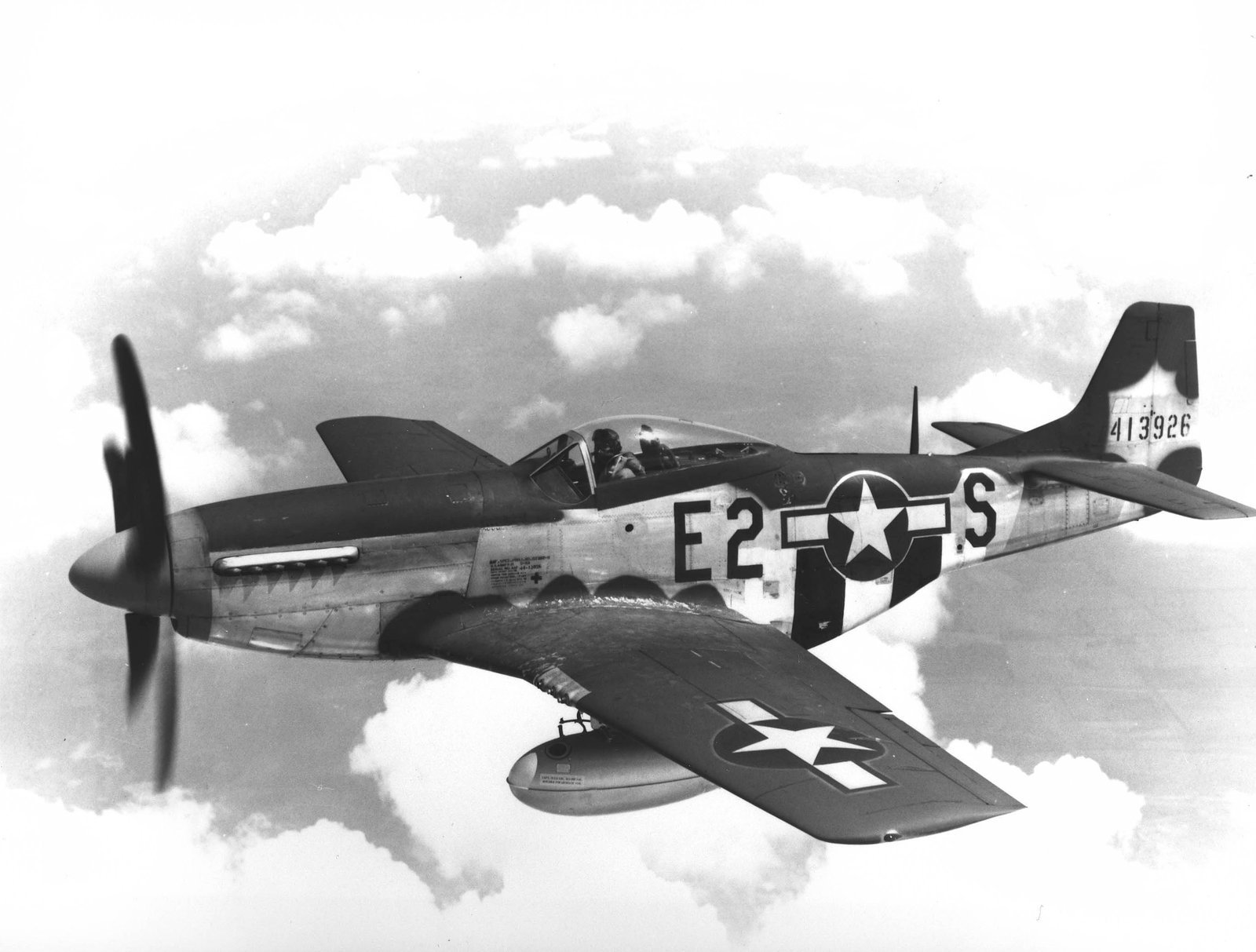
Through 1943 the American daylight bombing campaign was in trouble. Escort fighters simply couldn’t fly far enough to protect B-17s and B-24s on the deepest raids, and losses were heavy. With drop tanks under its wings, the Merlin-powered P-51 could go the whole distance.
By the time of the first major US heavy-bomber raid on Berlin in March 1944, about 175 P-51B and P-51C fighters were in service, flying escort alongside P-38s. Bomber crews called their escorts “little friends”, and the 353rd Fighter Group, whose markings the Smithsonian’s P-51D wears today, would escort the bombers deep into Germany and then strafe targets on the way home.
The P-51D: The Classic Shape
The P-51D, which arrived in quantity in the spring of 1944, is the version most people picture. It added:
- A bubble canopy, giving the pilot a clear view all round, including behind (the earlier “razorback” B and C had a framed canopy).
- Six .50-calibre machine guns instead of four, with a simplified ammunition feed.
- The K-14 gyroscopic gunsight, which helped pilots work out how far to lead a target.
Nearly 8,000 P-51Ds were built, making it the most numerous version. According to the National Museum of the US Air Force, the type destroyed 4,950 enemy aircraft in the air in Europe, more than any other USAAF fighter there. In the Pacific, P-51Ds flew from Iwo Jima from the spring of 1945 to escort B-29s over Japan.
By the Numbers (P-51D)
These figures come from the National Museum of the US Air Force fact sheet.
- Engine: Packard-built Merlin V-1650, 1,695 hp (1,264 kW)
- Maximum speed: 437 mph (703 km/h); cruise 275 mph (443 km/h)
- Range: 1,000 miles (1,610 km)
- Service ceiling: 41,900 ft (12,770 m)
- Wingspan: 37 ft (11.28 m); length: 32 ft 3 in (9.83 m)
- Maximum weight: 12,100 lb (5,490 kg)
- Armament: six .50-calibre machine guns, plus bombs or rockets
- Production, all versions: more than 15,000
The Red Tails
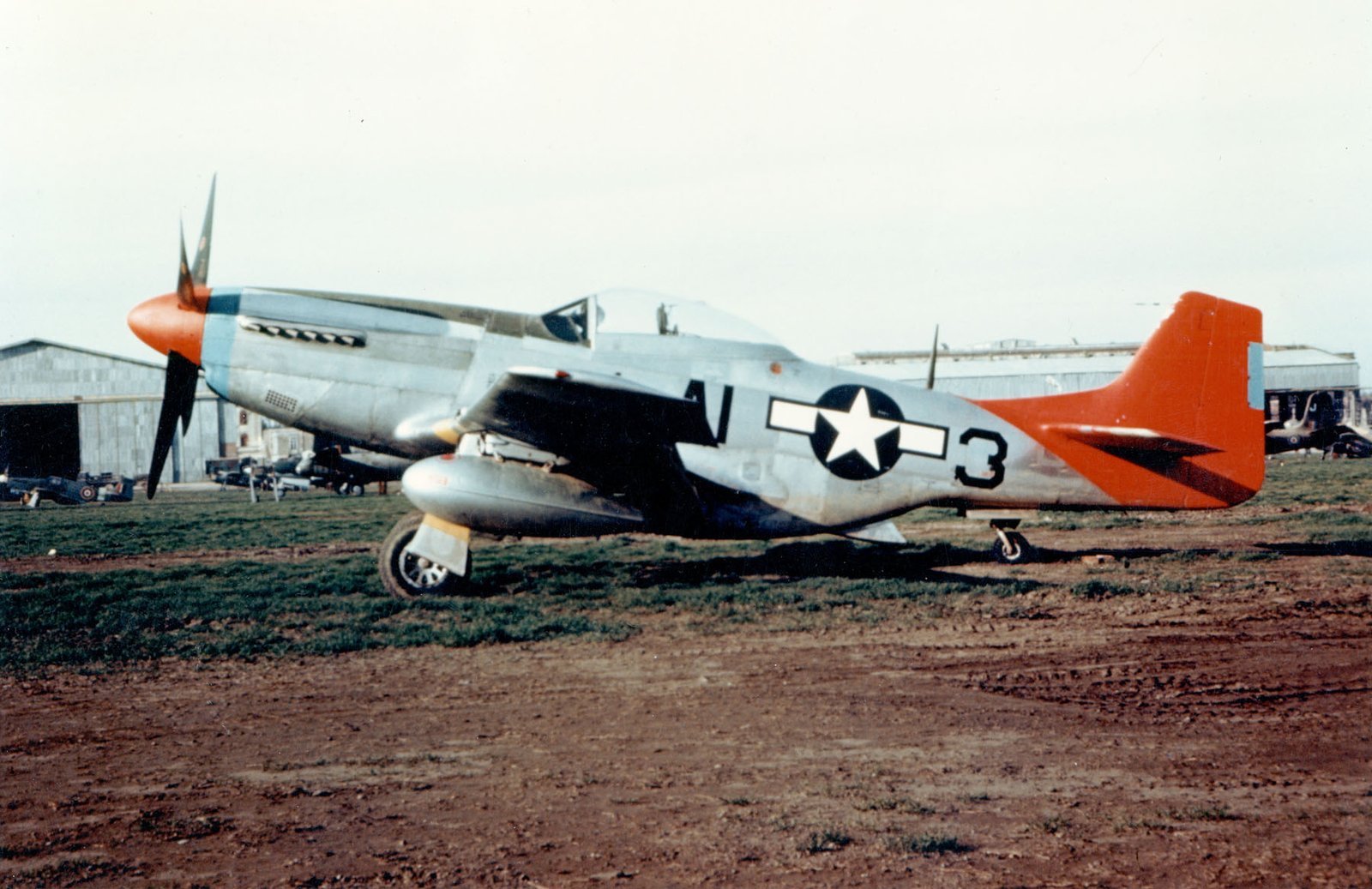
No story of this aircraft is complete without the Tuskegee Airmen. As we mentioned in our Stearman post, African American cadets learnt to fly at Moton Field in Tuskegee, Alabama, at a time when the US military was still segregated.
The 332nd Fighter Group, led by Colonel Benjamin O. Davis Jr., flew from Italy with the 15th Air Force. In July 1944 the group switched to P-51s and painted the tails bright red, which is how they became the “Red Tails”. From June 1944 to the end of the war the group flew 311 missions for the 15th Air Force, 179 of them bomber escorts. On 24 March 1945 they escorted B-17s on a long raid to Berlin and shot down three Me 262 jet fighters, earning a Distinguished Unit Citation.
About 990 pilots trained at Tuskegee, and some 350 went overseas. Their record is widely credited with helping make the case for desegregating the US armed forces after the war.
Down Under: Built in Melbourne
Australia has its own chapter. Commonwealth Aircraft Corporation (CAC) at Fishermans Bend, Melbourne, built 200 of these fighters under licence for the RAAF. The first 80 were assembled from kits supplied by North American as the CA-17, and the rest were built locally from scratch as the CA-18. The first Australian-assembled aircraft, A68-1, flew on 29 April 1945, too late for combat in WWII: only 17 had been delivered by VJ Day. The RAAF also received nearly 300 US-built P-51Ds and P-51Ks, and No. 3 Squadron RAAF flew the type in Italy from late 1944.
Korea
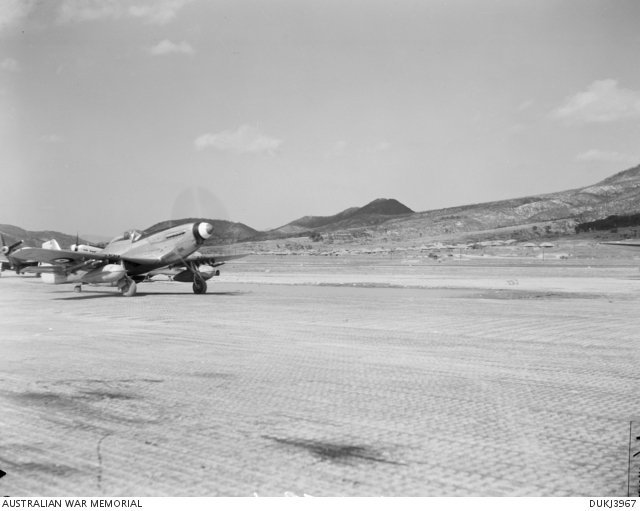
When war broke out in Korea in 1950, the fighter was back in action, now redesignated the F-51 in USAF service. It could reach targets from bases in Japan that the early F-80 jets couldn’t, and it was flown by the USAF, the Republic of Korea Air Force, the South African Air Force and the RAAF.
No. 77 Squadron RAAF, flying from Iwakuni in Japan, went into action on 2 July 1950, the first British Commonwealth unit to see action in Korea. It flew its last operations on the type in early April 1951 before converting to Gloster Meteor jets. In the US, F-86 Sabres had largely replaced the F-51 in combat by 1953, and the Air National Guard flew its last in 1957. In Australia, the RAAF’s last went in 1959, replaced by Vampire jets.
Racing: From Reno to Roswell
After the war, surplus fighters became prized civilian warbirds, and the P-51 found a second career as a racer. From 1964 the National Championship Air Races were held in northern Nevada, where modified P-51s were stars of the Unlimited class for decades. The 2023 event was the last at Reno-Stead.
The races have since moved to Roswell, New Mexico. After sitting out 2025, the Unlimited class made its Roswell debut on 16–20 September 2026, and Steven Hinton won Unlimited Gold in the P-51D Bardahl Special at an average of 432.897 mph (696.7 km/h). Not bad for a design that first flew in 1940.
Where to See One Today
These aircraft are among the most popular warbirds in the world, and plenty are still flying. Always check the venue’s own website for opening hours, flying days and bookings before you go.
In the USA
- National Museum of the US Air Force, Dayton, Ohio: P-51D Shimmy IV, plus the museum’s excellent fact sheets. nationalmuseum.af.mil
- Smithsonian National Air and Space Museum, Washington, D.C.: the P-51D Willit Run? is displayed in the Jay I. Kislak World War II in the Air gallery, which opened on 1 July 2026. airandspace.si.edu
- Planes of Fame Air Museum, Chino, California: “We fly our planes!” Check its flight schedule for flying days. planesoffame.org
- CAF Red Tail Squadron: its P-51C Tuskegee Airmen tours air shows and events across the US, telling the Tuskegee story. cafriseabove.org
- Stallion 51, Kissimmee, Florida: flight training and experience flights in dual-control TF-51s. stallion51.com
In Australia
- RAAF Museum, Point Cook, Victoria: the heritage CA-18 A68-170 is part of the Air Force Heritage Fleet flown by No. 100 Squadron, which puts on interactive flying displays on as many museum open days as possible. Flying isn’t guaranteed, so contact the museum to check before you go. Bookings are essential, and visitors over 16 need photo ID to enter the base. airforce.gov.au
- Australian War Memorial, Canberra: an example is displayed among the Korean War aircraft in the Aircraft Hall. awm.gov.au
- Fly in one, Brisbane: Fighter Pilot Adventure Flights at Archerfield offers P-51D flights. fighterpilot.com.au
- Fly in one, Melbourne: Mustang Joy Flights flies CA-18 VH-BOB from Point Cook, usually on Saturdays. mustangjoyflights.com.au
Our Art: Silver Warbird at Sunset
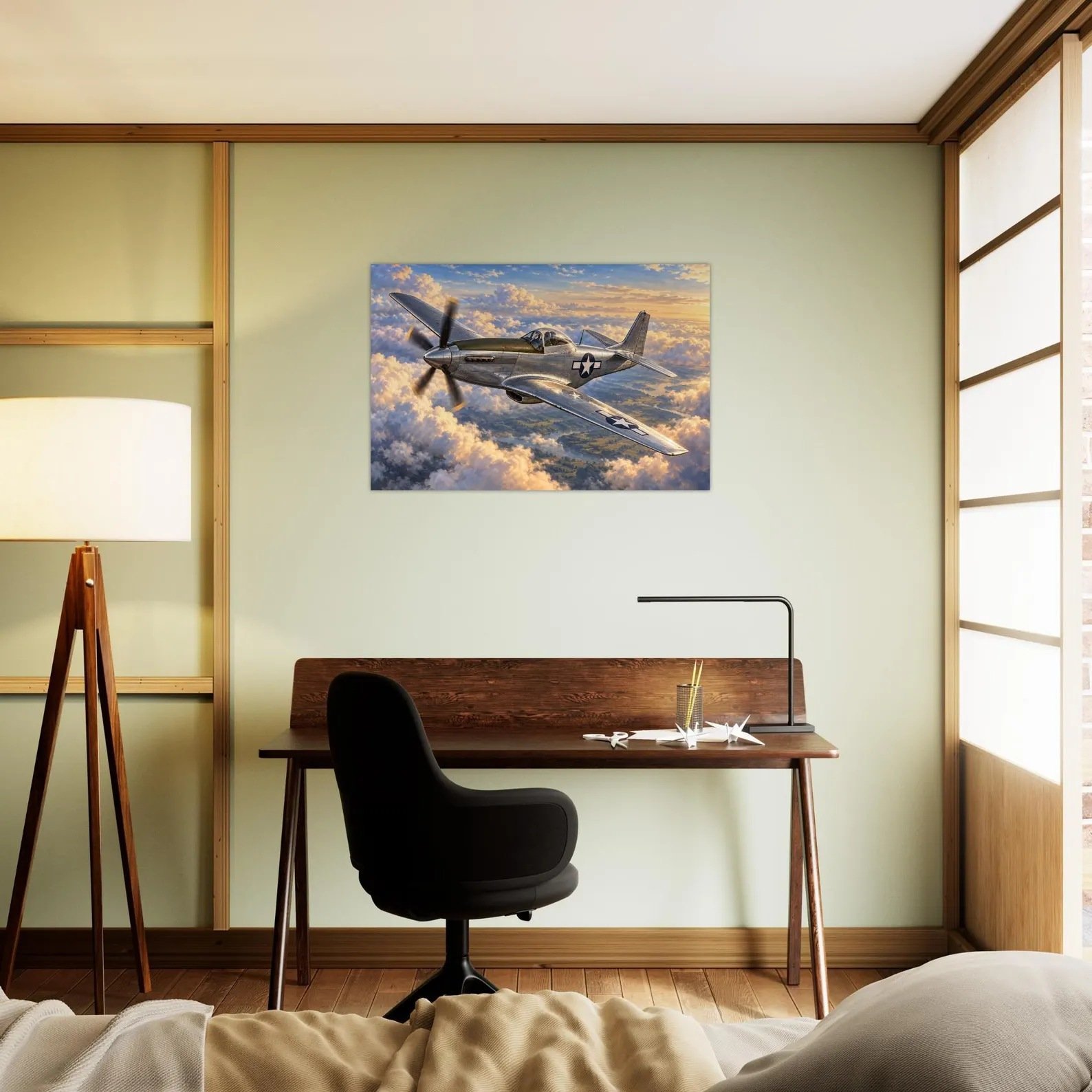
There’s something about a bare-metal WWII fighter catching the evening light. Our Silver Warbird at Sunset print shows a silver bubble-canopy fighter in US markings cruising above glowing sunset clouds, with a river winding through the landscape far below. It’s the kind of picture that belongs above a desk, in a hangar office or on the wall of anyone who grew up building model warbirds.
- Ready to hang: order the printed poster on Etsy.
- Print it yourself: get the digital download (3:2 ratio, sizes from 4×6 to 24×36 inches).
It would make a great Christmas gift for the aviation lover in your life. I created this print with the help of AI image tools.
Thanks for Flying With Us
From a rushed 1940 design for a British order to Berlin escorts, the Red Tails, Korea and the racecourse at Roswell, the North American P-51 packed a lot of history into a few short years, and it’s still thrilling crowds today. If you get the chance to hear a Merlin start up at an air show, take it.
Got a favourite WWII fighter, or a family connection to one? Tell us in the comments. And if this one’s your favourite too, take a look at the Silver Warbird at Sunset poster or digital download.
God bless you with blue skies!

Leave a Reply