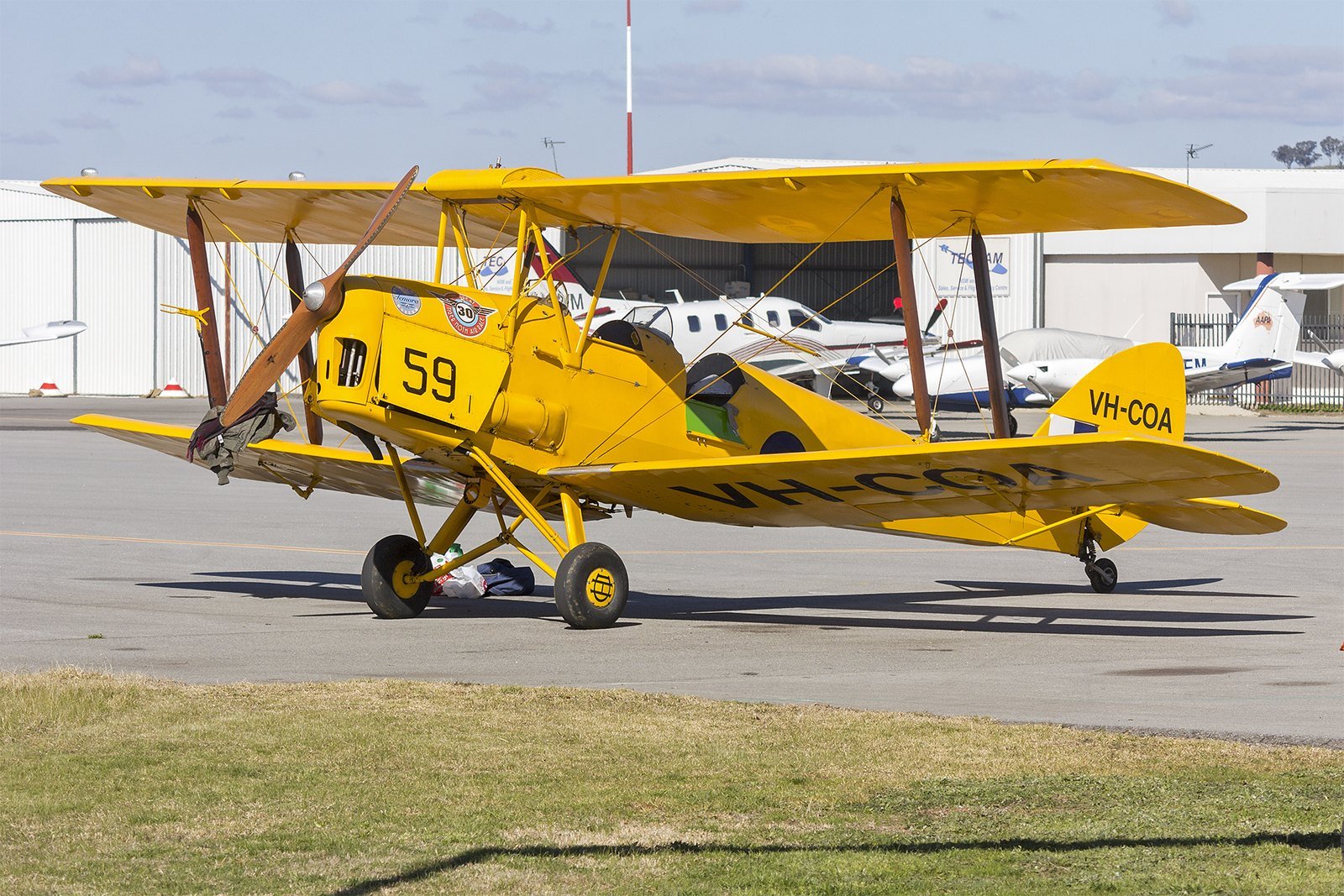
Featured image: de Havilland Australia DH-82A Tiger Moth A17-759 (VH-COA) at Wagga Wagga Airport. Photo: Bidgee, CC BY-SA 3.0 AU, via Wikimedia Commons.
Ninety-five years ago, on 26 October 1931, a little biplane called E6 lifted off from Stag Lane Aerodrome in Edgware, north London, with de Havilland’s chief test pilot Hubert Broad at the controls. It was the first true de Havilland DH.82 Tiger Moth, and it went on to teach tens of thousands of young people across the Commonwealth to fly.
Here in Australia, the Tiger Moth isn’t just a famous old aeroplane. It’s our trainer. More than a thousand were built in Sydney, it served at flying schools from Tamworth to Western Junction, and you can still climb into an open cockpit and fly in one today.
If you read our post on the Boeing-Stearman Kaydet, think of this as its Aussie twin. The Stearman taught America to fly. The Tiger Moth did the same job for Britain, Australia and much of the Commonwealth.
From Moth to Tiger Moth
Geoffrey de Havilland had already struck gold with the DH.60 Moth, a light biplane that put flying within reach of clubs and private owners. The Royal Air Force wanted a dedicated ab initio trainer (that’s a trainer for complete beginners), and de Havilland developed the DH.60T “Tiger” Moth into what became the DH.82, built to the Air Ministry’s Specification 15/31.
One problem needed solving first. In the earlier Moths, the fuel tank and the struts holding up the top wing sat right above the front cockpit, which made it hard to get out in a hurry, especially wearing a parachute. De Havilland’s answer was neat: shift the top wing forward so the front seat was clear, then sweep the wings back slightly to keep the centre of lift in the right place. That gentle sweep is one of the easiest ways to pick a Tiger Moth from other biplanes of its era.
A Few Clever Details
- Differential ailerons. The ailerons are on the lower wing only, and they’re rigged to deflect mostly upwards and hardly at all downwards. That reduces adverse yaw, the tendency of the nose to swing away from a turn, though pilots still need some rudder in turns. The circular bell crank that drives them sits flush with the fabric under the lower wing.
- A trainer that keeps you honest. Its big wings are forgiving and its stall and spin behaviour is benign, but it needs positive, prompt control movements. Some instructors liked that, because it helped weed out students who weren’t cut out for flying.
- Simple to own and fly. It was cheap to own and maintain, and from late 1934 the improved DH.82A (the RAF’s Tiger Moth II) used the 130 hp (97 kW) de Havilland Gipsy Major engine.
The RAF’s first Tiger Moths reached the Central Flying School in February 1932. Orders soon followed from more than 25 air forces.
By the Numbers
The DH.82A had a wingspan of 8.94 m (29 ft 4 in) and a top speed of about 175 km/h (109 mph). According to the RAAF, de Havilland and its partners built 8,811 Tiger Moths between 1931 and 1945, in seven countries.
Made in Bankstown: The Australian Tiger Moth
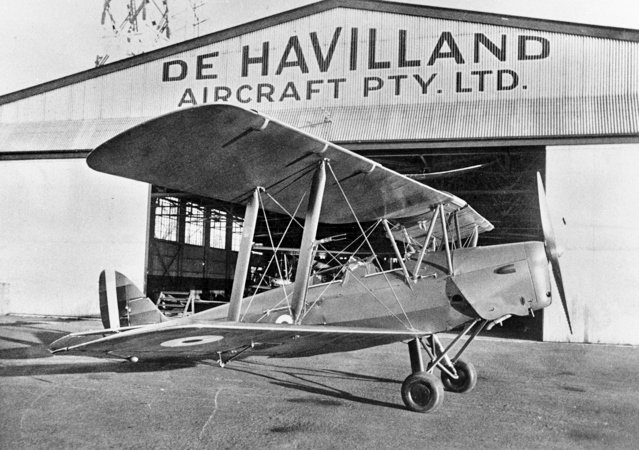
De Havilland’s Australian company started small. In 1939 it delivered 20 Tiger Moths to the Royal Australian Air Force, assembled from imported fuselages with locally built wings. After war broke out, the RAAF chose the Tiger Moth as its primary trainer, and in 1940 de Havilland Australia began licence production at a new factory at Bankstown in Sydney. The first Australian-assembled Tiger Moth flew there in late 1940.
By the time production ended in February 1945, 1,070 Tiger Moths had been built in Australia. Most went to the RAAF, but batches also went overseas, including 18 for the US Army Air Forces and 41 for the Royal Indian Air Force. Even the engines had an Aussie connection: Gipsy Major engines were built under licence in Australia by General Motors-Holden.
Training a Generation: The Empire Air Training Scheme
When the Second World War began, Britain worked out it needed about 50,000 new aircrew a year and could supply fewer than half of them itself. The answer was a joint training plan with Canada, Australia and New Zealand, signed on 17 December 1939. Here it was called the Empire Air Training Scheme, or EATS.
Australia promised 28,000 aircrew over three years, about 36 per cent of the total. The first courses started on 29 April 1940. By the time the scheme wound up, more than 37,000 Australian airmen had trained under it.
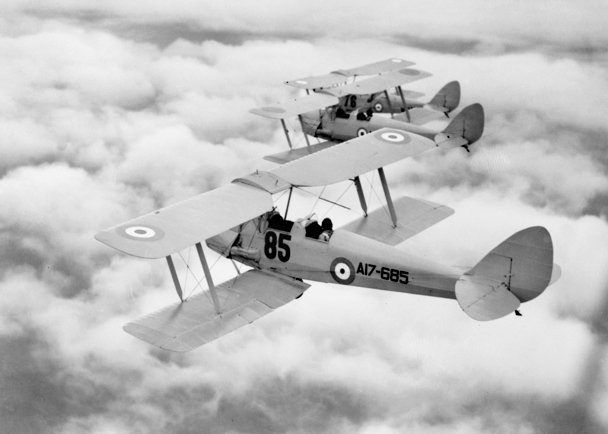
For would-be pilots, the first stop was one of 12 Elementary Flying Training Schools (EFTS), from Parafield and Archerfield to Narromine, Narrandera, Temora, Benalla, Cunderdin and Western Junction in Tasmania. The aircraft was almost always the Tiger Moth. Trainees aimed to go solo after about seven to ten hours, then kept going with instrument flying, navigation, night flying and aerobatics before moving on to service flying school.
It’s worth remembering what that meant. Many of the young people who learned to fly in a Tiger Moth over a country town went on to serve in Europe, the Middle East and the Pacific, and not all of them came home.
A Long Retirement (That Never Quite Happened)
The RAF replaced its Tiger Moths with the de Havilland Chipmunk in the early 1950s, and surplus aircraft poured onto the civil market. In Australia they became the backbone of aero clubs, flying schools and private hangars.
The RAAF’s own history of Tiger Moth A17-692 sums up the type’s working life. It trained pilots at No. 5 EFTS Narromine and No. 10 EFTS Temora during the war, then went to the Royal Australian Navy at HMAS Albatross, where it served until 1958. It may well have been the last Tiger Moth operated by the Australian military. Today it belongs to the RAAF Museum, and in 2023 it went to Luskintyre in NSW for a refurbishment before returning to the air with No. 100 Squadron.
Then there’s A17-691. As VH-UVZ it was only the second DH.82A imported into Australia, registered in August 1936. On 21 April 1937 it crashed into Sydney Harbour, and remarkably, it was recovered and flew again. In August 1940 it was impressed into the RAAF as A17-691 and served at No. 10 EFTS Temora. In December 2000 it was donated to the Temora Historic Flight, and it’s now part of the RAAF’s heritage fleet.
Where to See a Tiger Moth in Australia
- RAAF Museum, Point Cook, Victoria: Home of A17-692 and No. 100 Squadron, which flies heritage aircraft at the museum. Flying isn’t scheduled on every open day, so contact the museum to check before you go (bookings and photo ID are needed to enter the base).
- Temora Aviation Museum, NSW: Houses the RAAF No. 100 Squadron Historic Flight collection, including Tiger Moth A17-691. The museum is open daily, but it says no flying displays are scheduled there in 2026 or 2027, so check its Facebook page for where the aircraft will appear.
- Australian War Memorial, Canberra: Holds Tiger Moth A17-704, built in 1943, which served with No. 1 EFTS at Tamworth.
- Mackay Tiger Moth Museum, Queensland: Formed in 1974 (as the Tiger Moth Trust) to buy a locally restored Tiger Moth that was in danger of being sold to America. Its hangar beside the Mackay Aero Club is open most Saturday and Sunday mornings, weather permitting.
Where to Fly in a Tiger Moth
Nothing beats the real thing: leather helmet, goggles, wind in the wires and a Gipsy Major ticking over in front of you. These operators each list Tiger Moth joy flights on their own websites:
- Royal Newcastle Aero Club, Maitland, NSW: A DH-82 Tiger Moth restored in the club’s own workshop, with flights over the Hunter Valley, Pokolbin vineyards, Luskintyre and Newcastle.
- Tiger Moth Joy Flights Yarra Valley, Lilydale, Victoria: Scenic and aerobatic flights over the Yarra Valley in DH-82A Tiger Moth VH-DHR, about an hour from Melbourne.
- Mackay Tiger Moth Museum, Queensland: Joy flights in one of its two Tiger Moths along the Mackay coast (longer flights also cross the cane fields), most weekends.
Operators set their own age, height and weight limits, and every flight depends on the weather. Check each operator’s website for current details and prices before you book. A Tiger Moth flight also makes a pretty special gift for the aviation lover in your life.
A Classic for Your Wall

Ninety-five years old and still flying: if any aeroplane has earned the right to say “I’m not old, I’m a classic”, it’s the Tiger Moth. That “still going strong” spirit is exactly why we love our “I’m Not Old, I’m a Classic” biplane poster. It’s a polished chrome vintage biplane in front of a retro striped sunset, and it makes a fun gift for the pilot, aero club member or birthday legend in your life who’s proudly a classic themselves.
And if you prefer your biplanes from the other side of the Pacific, our Stearman Biplane in Flight print is the Tiger Moth’s American cousin, in blue and yellow.
Thanks for Flying With Us
Ninety-five years on, the Tiger Moth is still doing what it does best: putting a grin on the face of anyone who flies in one. Have you flown in a Tiger Moth, or did someone in your family train in one during the war? We’d love to hear the story.
God bless you with blue skies!