Tag: CASA

  • Australian Airshows and Fly-Ins: A Summer Planning Guide

    Australian Airshows and Fly-Ins: A Summer Planning Guide

    There’s nothing quite like the moment a fast jet’s sound catches up with it, a split second after it’s already flashed past the crowd line. Or the deep, lazy rumble of a radial engine as a vintage aeroplane taxis by close enough to smell the oil. If you’ve never been to an airshow, an Australian summer is a great time to start, and if you’re already hooked, the 2026–27 season has a big one on the calendar.

    This guide covers the confirmed events coming up, how to find the smaller fly-ins near you, what to pack for a long day on a hot airfield, and a few tips for coming home with photos you’ll actually want to keep.

    A quick note before you plan: every date below was checked on the event’s official website (or its organiser’s) on 6 November 2026. Airshows can change at short notice because of weather, aircraft availability or safety reasons, so always check the official site again before you book travel or tickets.

    The Big One: Avalon 2027

    The Avalon Australian International Airshow is Australia’s largest international airshow, and it’s back at Avalon Airport near Geelong, Victoria, from 23 to 28 February 2027. That’s earlier in the year than some past shows. The Geelong Independent reports the move was made to avoid clashing with Easter, the AFL season and the Formula One Grand Prix.

    Here’s how the week breaks down, according to the organisers:

    • Trade days first. The week opens with three dedicated trade and industry days. These are for aviation, aerospace and defence businesses rather than the general public.
    • Public program from Friday 26 February. This includes Friday Night Alight, the twilight show the organisers describe as a crowd favourite, with aerial performances lighting up the evening sky.
    • The Saturday and Sunday airshow (27 and 28 February). Two full days of flying displays, which the organisers say will include military jets, precision aerobatics and historic aircraft, plus ground exhibits and family activities.

    The official site also has pages for a General Aviation Precinct and aircraft experiences, so it’s worth a look if you’re a private pilot or just love light aircraft. The organisers say tickets go on sale through Ticketek in November 2026, so if you’re keen, sign up to their newsletter on the official site to hear when they’re released.

    Avalon tip: it’s a big site and a big crowd (the organisers say the last event drew more than 200,000 visitors), so plan your transport and arrive early. Check the official Plan Your Visit page for parking and transport options closer to the date.

    Visitors walking between exhibitor stalls and a yellow airport fire truck on a cloudy day at the Avalon airshow.
    Crowds on the second public day of the 2015 Australian International Airshow at Avalon. Photo: Bidgee, CC BY-SA 3.0, via Wikimedia Commons.

    Smaller Shows and Fly-Ins This Season

    Not every great aviation day out is a huge international show. Fly-ins, where pilots fly their own aircraft in to an airfield for the day or weekend, are often friendlier, quieter and give you a better chance to chat with owners. Here are some confirmed on official sites:

    • Rotax Fly-In Australia, Saturday 21 November 2026, Caloundra Aerodrome (Queensland). Hosted by Bert Flood Imports and Aircraft Maintenance Specialists, with Rotax-powered recreational, sport and classic aircraft on display, exhibitors, food trucks and free seminars including speakers from CASA, RAAus and the SAAA. Registration is through the Rotax Fly-In Australia page. (The Sport Aircraft Association of Australia’s events list shows it as a Friday-to-Sunday weekend, 20 to 22 November, so check the Rotax page for the full program.)
    • Lake Boga Splash Down Christmas Party, 4 to 6 December 2026, Lake Boga (Victoria). This is the Seaplane Pilots Association of Australia’s fly-in and Christmas function, with seaplanes parked at the ski club ramp next to Lake Boga’s Catalina museum, a Murray River paddle-steamer cruise and a laser light show over the water. It’s mainly a members’ event, so read the details and registration notes on the SPAA events page before you go.

    Looking ahead to autumn 2027

    These two are just outside summer, but both have confirmed 2027 dates and early ticket information, so they’re worth pencilling in now:

    • Hunter Valley Airshow, 3 and 4 April 2027, Cessnock Airport (NSW). The official site has early-bird tickets and pairs the flying with wine and street food.
    • Wings Over Shellharbour, 22 and 23 May 2027, Shellharbour Airport, Albion Park (NSW). The official site says more than 20,000 visitors came to the 2026 show, and calls it the only major airshow within easy reach of Sydney and Canberra.

    What about Temora and Tyabb?

    Two favourites are taking a breather. The Temora Aviation Museum’s events page says there are currently no flying displays scheduled there during 2026 or 2027, although the museum itself is still open for visits, and the RAAF No. 100 Squadron Historic Flight aircraft it looks after continue to appear at selected events on the east coast. The Tyabb Airshow on Victoria’s Mornington Peninsula is a biennial event that last ran on 1 March 2026.

    A camouflaged Supermarine Spitfire taxiing on the tarmac at Avalon.
    Temora Aviation Museum’s Spitfire Mk XVI (VH-XVI) taxiing at the 2019 Australian International Airshow. Photo: Bidgee, CC BY-SA 3.0 AU, via Wikimedia Commons.

    How to Find Events Near You

    Big airshows get plenty of publicity, but local fly-ins and aero club open days often only get a mention in pilot circles. Good places to look:

    • The Sport Aircraft Association of Australia (SAAA) keeps an events list covering airshows and fly-ins around the country.
    • Recreational Aviation Australia (RAAus) lists events on its website, including its own national fly-ins.
    • Your local aero club or flying school. Many hold open days, and they’re usually happy to welcome visitors who are curious about learning to fly.
    • Aviation museums. Many run open cockpit days and special events, and they usually announce them on their own websites and social media pages.
    • Your state tourism or events website, which often lists regional airshows alongside other local events.

    Whatever you find, always confirm the details on the event’s own website or social media before you set off.

    What to Bring to an Airshow

    Airfields are big, flat and usually short on shade, and a summer airshow can mean hours in the sun. Pack as if you’re heading to the cricket for the day:

    • Sun protection. A broad-brimmed hat, sunscreen, sunglasses and a long-sleeved shirt. Reapply sunscreen through the day.
    • Plenty of water. Check the event’s rules on what you can bring in; many have refill stations.
    • Hearing protection, especially for children. Jet displays are loud. Earplugs or earmuffs make the day far more comfortable, and kids’ earmuffs are a must for little ones.
    • Something to sit on. A folding chair or picnic rug, if the event allows them in the spectator areas.
    • Comfortable shoes. You’ll walk a lot more than you expect, often on grass or gravel.
    • A charged phone and a small power bank, plus cash or a card for food and drinks.
    • Leave the drone at home. CASA’s drone rules say you must not fly over or above people or in populous areas, which include events, so an airshow is no place for a recreational drone. See CASA’s drone rules.

    Airshow Photography Tips

    You don’t need a big camera to get good airshow photos, but a few habits make a big difference:

    • Find the light. Note where the sun is when you arrive. Shooting with the sun behind you gives brighter, more colourful pictures, while shooting into it turns aircraft into silhouettes (which can look great at a twilight show).
    • Show the propeller turning. With propeller aircraft, a very fast shutter speed freezes the prop so it looks as if the engine has stopped. A slightly slower shutter speed lets the blades blur into a disc, which looks far more alive. Experiment, and take plenty of shots.
    • Use burst mode. Fast jets cross your frame in a moment. Holding the shutter down for a burst gives you a better chance of a sharp, well-framed shot.
    • Don’t forget the ground. Some of the best photos are taken on the flight line: close-ups of nose art, pilots climbing in, or a vintage aeroplane’s engine coughing into life.
    • Put the camera down sometimes. The best moments are often the ones you simply watch.
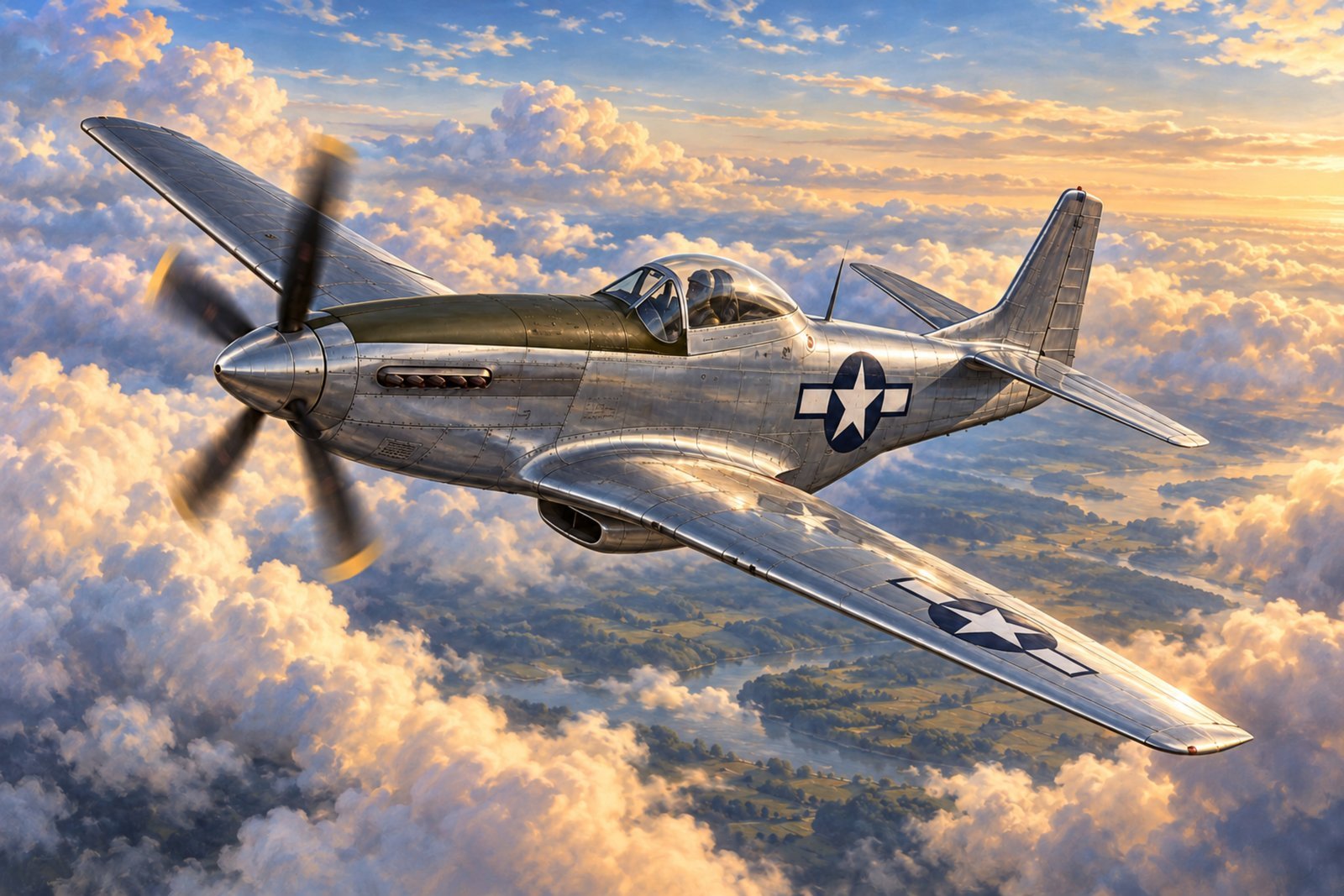
    Artwork of a polished silver WWII fighter flying through glowing sunset clouds.
    WWII Fighter Warbird in Sunset Clouds, from the PlanesNStuff art collection. Available as a poster or digital download.

    Bring a Bit of the Airshow Home

    If you love the sight of a polished warbird against an evening sky, our own WWII Fighter Warbird in Sunset Clouds print captures exactly that. It’s available as a printed poster or as a digital download, and you can see the rest of the collection in our Art Shop.

    Bring a warbird home from the show

    If an airshow day leaves you wanting something for the shelf as well as the wall, these Airmodels die-cast favourites capture the kinds of classics that still thrill Australian crowds: a premium P-51C, a Tiger Moth floatplane, and a Spitfire Mk Vb.

    P-51C Mustang - "Alice-Jo" die-cast model aircraft, 1/48 scale
    Image: Airmodels

    P-51C Mustang – "Alice-Jo" (1/48 scale)

    de Havilland DH.82A Tiger Moth Royal Navy die-cast model aircraft, 1/72 scale
    Image: Airmodels

    de Havilland DH.82A Tiger Moth Royal Navy (1/72 scale)

    Supermarine Spitfire Mk Vb die-cast model aircraft, 1/72 scale
    Image: Airmodels

    Supermarine Spitfire Mk Vb (1/72 scale)

    About our links: this is an affiliate link, so PlanesNStuff may earn a small commission at no extra cost to you.

    Keep Exploring

    If an airshow has sparked your interest in the aircraft themselves, you might enjoy our stories on the de Havilland Tiger Moth, the de Havilland Dragon and the WWII fighter that escorted the bombers all the way. And if watching the flying makes you want to try it yourself, our beginner’s guide to RC planes is a great place to start.

    Have we missed a fly-in or airshow in your part of Australia? Let us know, and we’ll check it out for a future update.

    God bless you with blue skies!

  • Getting Started in RC Planes: Trainers, Simulators and First Flights

    Getting Started in RC Planes: Trainers, Simulators and First Flights

    We haven’t tested these products ourselves. This roundup is based on manufacturer information, published specifications and owner reviews.

    There’s something special about watching a model aeroplane you’re controlling climb away into a clear sky. Radio-control (RC) flying has hooked people for generations, and these days it has never been easier to get started. Foam airframes bounce instead of shattering, electric motors have replaced fiddly fuel engines on most beginner models, and clever stabilisation systems can catch you before a small mistake becomes a big one.

    But there’s still a learning curve, and plenty of first flights end in a heap of foam. This guide walks you through the route most experienced flyers recommend: learn on a simulator, pick a proper trainer, check the rules where you live and, ideally, join a club.

    Step 1: Start on a Simulator

    The cheapest crash is the one that happens on a screen. An RC flight simulator lets you practise with a real transmitter-style controller on your computer, so your thumbs learn the movements before you risk an actual aeroplane. The trickiest skill for most beginners is flying the plane when it’s coming towards you, because left and right appear reversed. A simulator lets you practise that over and over, and when you crash, you just press reset.

    A few options worth knowing about:

    • RealFlight from Horizon Hobby is one of the best-known RC simulators. Horizon calls it “the #1 RC flight simulator in the world”. The full RealFlight Evolution package lists more than 300 aircraft and over 75 flying sites, with Virtual Flight Instructor lessons, multiplayer and VR support. A cut-down Trainer Edition comes bundled with some beginner aeroplanes (more on that below).
    • PicaSim is a free RC simulator for Android, iOS and Windows. Its developer says it mainly concentrates on gliders, with a few powered planes, and that development is on hold for now, but it’s a no-cost way to get a feel for the controls. See the PicaSim website.

    Even half an hour a day on a simulator in the week before your first flight can make a real difference to how relaxed you feel at the field.

    A red and white RC aerobatic plane hitting the grass nose-first beside a runway.
    Coming a cropper: every RC pilot has a crash story, which is why practising on a simulator first pays off. Photo: Bob Adams, CC BY-SA 2.0, via Wikimedia Commons.

    What Makes a Good Trainer Plane?

    A “trainer” is a model designed to be forgiving. Not every model that looks pretty in the hobby shop is a good first plane; scale warbirds and fast sport models can be a handful even for experienced pilots. Look for these traits:

    • A high wing. With the wing above the fuselage, the plane naturally tends to level itself, a bit like a pendulum. Most classic trainers, and the full-size Cessnas and Cubs that many of them resemble, are high-wingers.
    • Gentle, slow flying. A trainer that can fly slowly gives you more time to think and react.
    • Tough foam construction. Most beginner models today are made from moulded foam (often EPO), which shrugs off minor knocks and can be glued if it breaks.
    • Electronic stabilisation. Many modern trainers include a stabilisation system that limits how far the plane can bank or pitch and can level it out when you let go of the sticks. Horizon Hobby’s version is called SAFE (Sensor Assisted Flight Envelope), and some models add a “panic” recovery button.
    • Spare parts you can actually buy. You’ll break a propeller or landing gear sooner or later. Popular models from major brands are easier to repair.

    RTF, BNF and “RTF Basic”: what’s in the box?

    • RTF (Ready-to-Fly) usually includes the plane, a transmitter, a flight battery and a charger, so you can fly almost straight away.
    • RTF Basic (Horizon Hobby’s term) includes the plane and transmitter, but the battery and charger are sold separately.
    • BNF (Bind-N-Fly) includes the plane and receiver but no transmitter. It suits people who already own a compatible radio.

    Always read the “needed to complete” list on the listing before you buy, so there are no surprises on flying day.

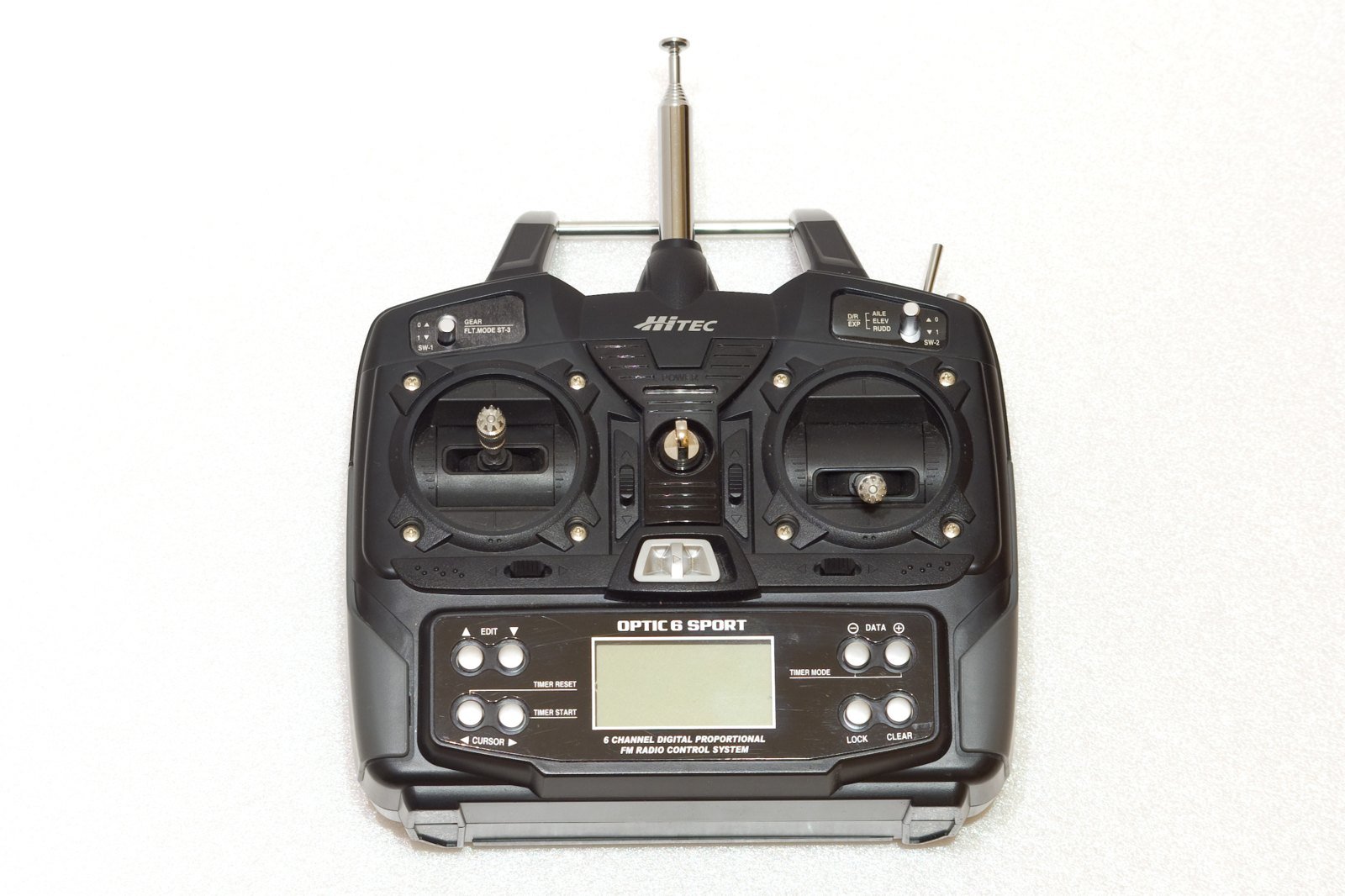
    A black Hitec Optic 6 Sport handheld radio-control transmitter with two control sticks and an aerial.
    A Hitec Optic 6 Sport six-channel transmitter. Your transmitter’s two sticks control throttle, rudder, elevator and ailerons. Photo: Foma39, CC BY-SA 3.0, via Wikimedia Commons.

    Four Beginner RC Planes Worth a Look

    All four of these come from Horizon Hobby’s HobbyZone and E-flite brands, which are among the most widely sold beginner ranges, and all use SAFE stabilisation. Specifications are from the manufacturer’s listings. Availability changes often, so check before you plan around one.

    HobbyZone Sport Cub S 2 RTF with SAFE

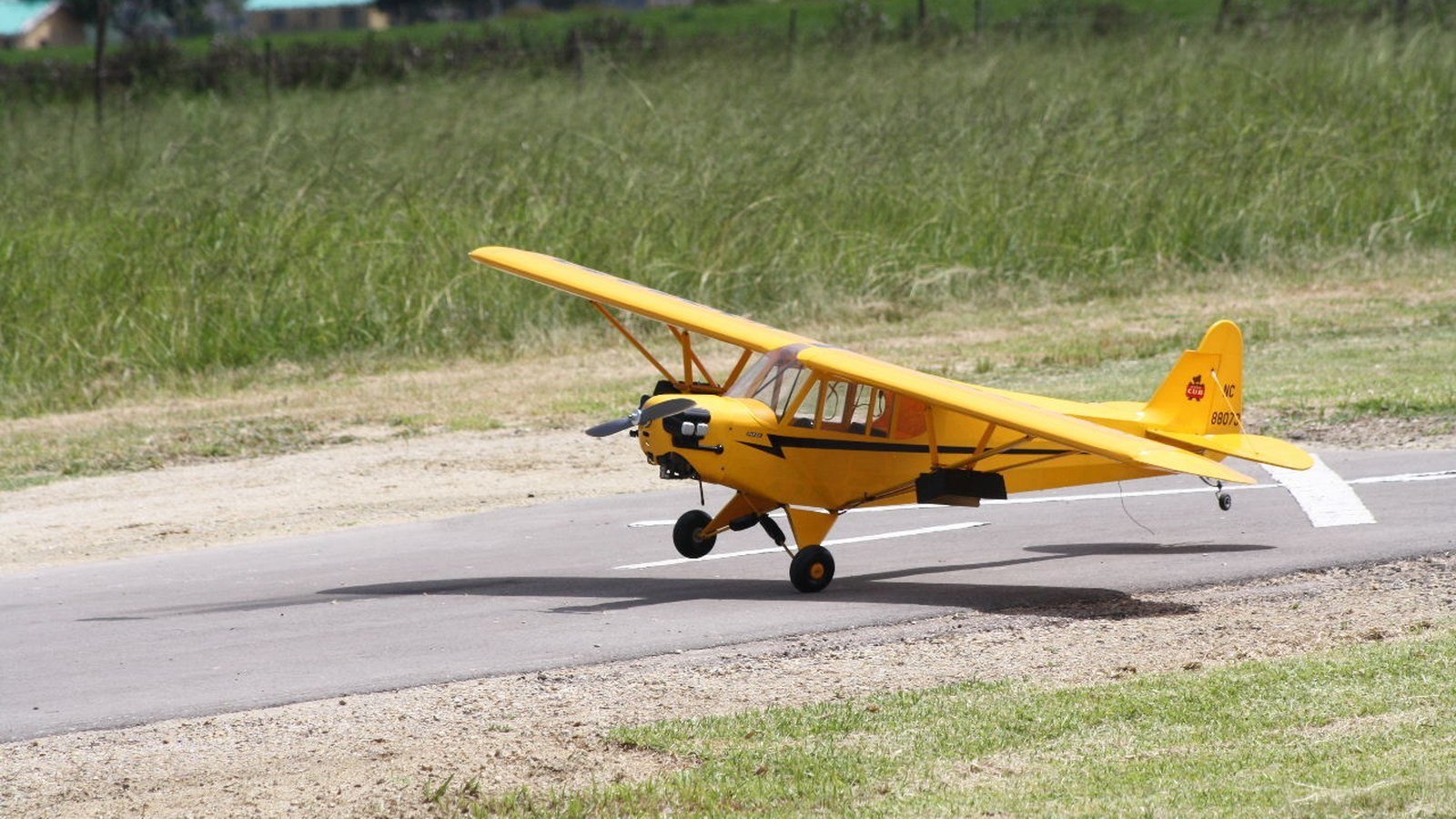
    The smallest and simplest of the bunch, styled after the classic Piper Cub.

    • Wingspan: 617 mm (24.3 in)
    • Flying weight: 61 g with its 1S 150mAh battery
    • In the box (RTF): battery, charger and transmitter
    • Simulator link: the transmitter has a USB-C port and works with the included trial of RealFlight Trainer Edition
    • Stabilisation: SAFE technology

    Why it suits beginners: it’s tiny, light and inexpensive to repair, and you get a simulator trial in the same box. At 61 g it’s well under the 250 g threshold that matters in both Australia and the US (see the rules below). Horizon pitches it for large yards and parks, but note that in Australia parks are classed as “populous areas” by CASA, so you’ll need a suitable open space or a club field. Very light models also struggle in wind, so save it for calm days. See the Sport Cub S 2 on Horizon Hobby.

    HobbyZone AeroScout S 2 1.1m RTF Basic with SAFE and RealFlight

    A purpose-built trainer with a pusher propeller at the back, which keeps the prop out of the way when you land on your nose.

    • Wingspan: 1095 mm (43.1 in)
    • Weight: 639 g without battery; 853 g with a 3S 2200mAh battery
    • Construction: EPO foam, tricycle landing gear, optional floats
    • Flight modes: Beginner, Intermediate and Experienced, so the plane grows with you
    • Simulator: includes the “full” version of RealFlight Trainer Edition (Windows 10 or 11 PC)
    • Needed to complete: 3S battery and charger (sold separately)

    Why it suits beginners: it’s big enough to handle a little more breeze than a micro, the tricycle gear makes take-offs and landings easier, and you get both the plane and a proper simulator in one purchase. See the AeroScout S 2 on Horizon Hobby.

    HobbyZone Carbon Cub S 2 1.3m RTF Basic

    For people who want their first plane to look like a “real” aeroplane. It’s based on the CubCrafters Carbon Cub, a modern take on the Piper Cub.

    • Wingspan: 1300 mm (51.18 in)
    • Weight: 913 g without battery
    • Landing gear: taildragger with big tundra tyres; optional floats
    • Options: SAFE Plus GPS and a Landing Assist Sensor can be added
    • Needed to complete: 3S battery and charger (sold separately)

    Why it suits beginners: it combines beginner-friendly stabilisation with scale looks, and it’s a model many pilots keep flying long after they’ve learned. A taildragger is a little trickier to take off than a tricycle-gear plane, so it’s worth practising on the simulator first. See the Carbon Cub S 2 on Horizon Hobby.

    E-flite Apprentice STS 1.5m RTF Basic Smart Trainer with SAFE

    The classic club trainer: big, stable and built to cope with more wind.

    • Wingspan: 1499 mm (59 in)
    • Weight: 1672 g
    • Options: SAFE Plus GPS and Landing Assist Sensor
    • Needed to complete: 3S 3200–4000mAh battery and charger (sold separately)
    • Background: the earlier Apprentice listing describes it as the Official Trainer of the Academy of Model Aeronautics (AMA) in the US

    Why it suits beginners: larger planes are generally more stable and easier to see, which is why this style of trainer is a favourite at club fields. It’s the biggest and heaviest here, so it’s best flown at a club field rather than a local reserve. At the time of writing Horizon listed it as back-ordered. See the Apprentice STS on Horizon Hobby.

    Know the Rules Before You Fly

    In both Australia and the US, model aeroplanes fall under the same rules as recreational drones. These are the basics; always check the official pages before you fly, because rules change.

    Australia (CASA)

    The Civil Aviation Safety Authority’s drone rules apply to model aircraft flown for fun. Key points include:

    • No licence, accreditation or registration is needed when you fly for fun, and there’s no age limit. You need CASA approval to fly anything over 25 kg.
    • Fly no higher than 120 m (about 400 ft) above the ground.
    • Keep at least 30 m away from other people.
    • Fly only one aircraft at a time, only in daylight, and keep it within your visual line of sight.
    • Don’t fly over or above people, or in populous areas such as beaches, parks, events or sports ovals while a game is on.
    • If your aircraft weighs more than 250 g, don’t fly within 5.5 km of a controlled airport.
    • CASA recommends using a CASA-verified drone safety app to check where you can fly.

    United States (FAA)

    The FAA’s recreational flyer rules cover model aircraft too. In short:

    • Register your aircraft if it weighs 250 g (0.55 lb) or more.
    • Pass The Recreational UAS Safety Test (TRUST). It’s free, and you must carry proof that you passed.
    • Follow the safety guidelines of an FAA-recognised community-based organisation.
    • Keep your aircraft within visual line of sight and give way to other aircraft.
    • Fly at or below 400 ft in uncontrolled (Class G) airspace; controlled airspace needs authorisation, through LAANC or the FAA’s DroneZone.
    • Registered aircraft must broadcast Remote ID, unless you’re flying at an FAA-Recognized Identification Area (FRIA), which many club fields are.

    We covered the US rules in more detail in our beginner drone guide, and they apply in the same way to model planes.

    Join a Club (Seriously, It Helps)

    The single best thing a beginner can do is find a local club. You get a safe, approved place to fly, experienced members who can check your plane over, and often an instructor who can help you through your first flights.

    • In Australia, the Model Aeronautical Association of Australia (MAAA) describes itself as Australia’s largest flying organisation, with more than 330 affiliated clubs and over 9,500 members, and it’s been around for more than 75 years. Its clubs have recognised flight instructors, it runs a Wings program for new pilots, and its website has a Find a Club tool and information on Have a Go flying.
    • In the US, the Academy of Model Aeronautics (AMA) calls itself the world’s largest model aviation association. Membership includes insurance and access to its chartered club flying sites, and it has a club finder on its website.

    Tips for Your First Real Flight

    • Pick a calm day. Wind is a beginner’s biggest enemy, especially with small, light models.
    • Charge everything the night before, including the transmitter, and always switch the transmitter on before the plane and off after it.
    • Do a pre-flight check. Make sure the control surfaces move the right way when you move the sticks, and that the propeller and battery are secure.
    • Take off into the wind and climb to a comfortable height before you try turns. Height gives you time to recover.
    • Keep the first flight short and simple. Gentle, wide circles are plenty. Use the beginner mode on your stabilisation system.
    • Expect a few bumps. Every RC pilot has a crash story. Pack some foam-safe glue and a spare propeller, and you’ll be back in the air quickly.

    Thanks for Flying With Us

    Learning to fly RC is one of the most rewarding corners of aviation, and with a simulator, a forgiving trainer and a friendly club, you’ll be making smooth circuits sooner than you think. If the Cub-style trainers above have you curious about the real thing, our story of the Tiger Moth shows how full-size pilots learned on a forgiving trainer too. And if you’d rather start with a camera drone, our beginner drone guide has you covered. For the hangar wall, take a look at the vintage-aviation prints in our Art Shop.

    What was your first RC plane, or which one is on your wish list? Tell us in the comments.

    Full-size trainers for the shelf

    While you learn on a foam RC trainer, a die-cast classic is a nice reminder of the full-size aeroplanes that taught generations of pilots. These Airmodels trainers sit well beside a Cub-style RC hangar.

    de Havilland DH.82A Tiger Moth die-cast model aircraft, 1/72 scale
    Image: Airmodels

    de Havilland DH.82A Tiger Moth (1/72 scale)

    Boeing N2S-3 Stearman die-cast model aircraft, 1/48 scale
    Image: Airmodels

    Boeing N2S-3 Stearman (1/48 scale)

    NA LT-6G Texan die-cast model aircraft, 1/72 scale
    Image: Airmodels

    NA LT-6G Texan (1/72 scale)

    About our links: this is an affiliate link, so PlanesNStuff may earn a small commission at no extra cost to you.

    God bless you with blue skies!