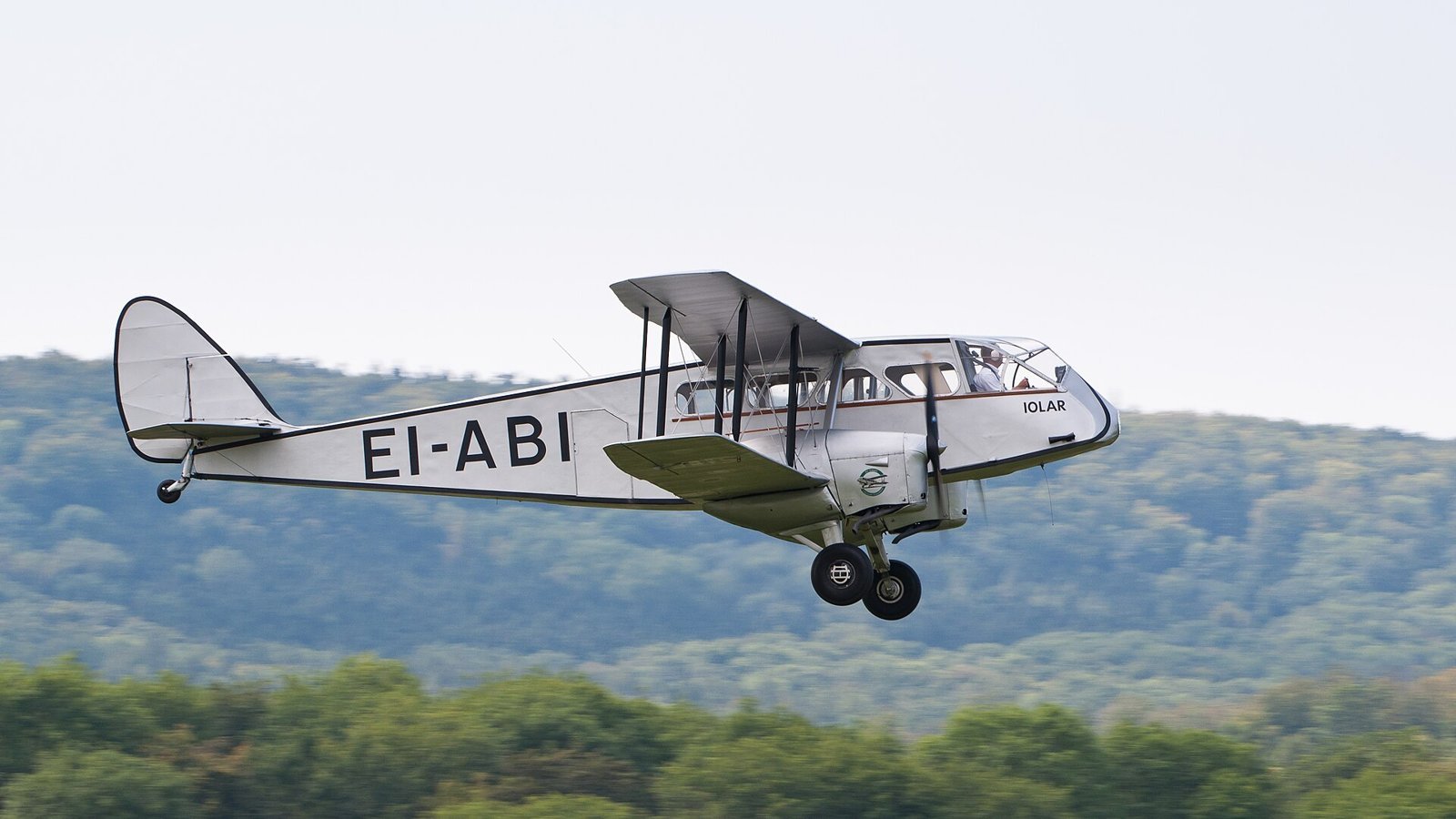
Featured image: Aer Lingus’s de Havilland DH.84 Dragon 2 Iolar (EI-ABI), built in 1936, flying in 2013. Photo: Julian Herzog, CC BY 4.0, via Wikimedia Commons.
Welcome to our first Classic Aircraft of the Month! Each month we’ll pick one much-loved aeroplane and dig into its story: where it came from, what made it special, and where you can still see one today.
We’re starting with an aircraft that doesn’t always get the spotlight but absolutely deserves it: the de Havilland DH.84 Dragon. It’s a twin-engined biplane with a boxy plywood fuselage and a cabin for six or more passengers, and in the 1930s and 40s it quietly did a bit of everything. It launched airlines, carried mail across the outback, trained wartime navigators and flew patients for the Flying Doctor. Australia even built its own.
A Bigger Moth for a Busy Airline
The Dragon grew out of de Havilland’s single-engined Fox Moth. The Fox Moth’s original commercial operator, Hillman’s Airways in England, asked de Havilland for a bigger, twin-engined version to carry more passengers on short routes.
De Havilland kept it simple. The Dragon used a light plywood box fuselage, the same type of de Havilland Gipsy engine as the earlier Moths, and outer wing panels similar to theirs. It was originally called the “Dragon Moth”, but it was sold as the Dragon. The prototype first flew at Stag Lane Aerodrome, north of London, on 12 November 1932, and Hillman’s started flying its first Dragons on scheduled services in April 1933.
Running costs were the big selling point. On Hillman’s London to Paris route, a Dragon could carry six passengers, each with 20 kg (45 lb) of luggage, while burning about 49 litres (13 gallons) of fuel an hour. For small airlines trying to make a profit, that was a very attractive number. Handy touch: the wing panels outboard of the engines folded back, so it took up less space in the hangar.
By the Numbers
According to A.J. Jackson’s de Havilland Aircraft since 1909, the original Dragon 1 had:
- a wingspan of 14.43 m (47 ft 4 in) and a length of 10.52 m (34 ft 6 in)
- two 130 hp (97 kW) de Havilland Gipsy Major four-cylinder engines
- a cruising speed of about 175 km/h (109 mph) and a range of about 740 km (460 miles)
- room for one pilot and six to ten passengers, depending on the layout
From the 63rd aircraft, late in 1933, de Havilland built the improved Dragon 2, with individually framed cabin windows and streamlined fairings on the undercarriage legs. The changes looked mostly cosmetic, but they added a little speed, payload and range.
Record Attempts and Airline Firsts
The Dragon’s long-legged potential caught the eye of some famous flyers. A specially modified Dragon called Seafarer, with extra fuel tanks in the cabin and strengthened landing gear, was built for Amy Johnson and her husband Jim Mollison to try for a long-distance record. In 1933 they flew it across the Atlantic from Pendine Sands in Wales to Bridgeport, Connecticut, in about 39 hours, only for the aircraft to overturn on landing.
A year later, in August 1934, another Dragon named Trail of the Caribou flew non-stop from Wasaga Beach in Ontario, Canada, to Heston Aerodrome, west of London, in 30 hours and 55 minutes. It was the first non-stop flight between the Canadian mainland and Britain.
The Dragon also has a special place in Irish aviation. On 27 May 1936, Aer Lingus flew its very first service, from Baldonnel near Dublin to Bristol, with a Dragon named Iolar, Irish for “eagle”. Today a 1936-built Dragon wears the same registration, EI-ABI, and the Iolar name. It’s the aircraft in our featured photo, and it has flown at airshows and events for the airline’s anniversaries.
The Dragon Down Under

The Dragon was a natural fit for Australia, where a few passengers, mail bags and freight had to cover huge distances to small country towns and stations. Airlines including Qantas, MacRobertson-Miller in Western Australia, Butler Air Transport and North Queensland Airways all flew them.
Running them out bush wasn’t glamorous. Aviation historian Geoff Goodall records that in November 1934 one of MacRobertson-Miller’s new Dragons was badly damaged in a forced landing after an engine failed soon after take-off at Halls Creek in the Kimberley. Horrie Miller, the airline’s founder, flew up from Perth and repaired it on his own over about four weeks, camping at the aerodrome and working in the open in extreme heat with minimal tools. He could only work until about noon each day, when the airframe got too hot to handle, and he used the plywood lining of tea chests to rebuild sections of the nose. That’s the kind of story that makes these old aeroplanes so loveable.
Made in Sydney: The Wartime Dragons
By the time the Second World War started, British production of the Dragon had already ended. De Havilland built 115 in England before replacing it on the production line with the faster, more elegant DH.89 Dragon Rapide.
So why did the Dragon come back? In July 1941 Australia’s Aircraft Production Commission warned the War Cabinet that Britain was unlikely to deliver more Anson and Oxford twin-engined trainers, so Australia needed twin-engined aircraft it could build itself. The Dragon had one big advantage over the Rapide: its Gipsy Major engines were already being built under licence in Australia by General Motors-Holden, for the Tiger Moth (you can read more about that in our post on the de Havilland Tiger Moth). The drawings, tools and jigs were shipped out from Britain, and de Havilland Australia began building Dragons in Sydney.
The War Cabinet approved the first 50 Dragons in September 1941 and more in January 1942. The first Australian Dragon was built by de Havilland craftsmen in the Grace Brothers building on Broadway in Sydney, assembled at Mascot Aerodrome, and first flew there on 29 September 1942. By June 1943, 87 had been completed, bringing total Dragon production to 202 aircraft. (You’ll often read that they were built at Bankstown, but historian Geoff Goodall and the ADF-Serials records both say Mascot.)
The RAAF used its Dragons mainly to train navigators, but they turned their hand to almost anything. They carried passengers, freight, mail and even fresh food to remote bases around Australia and in Papua New Guinea, and some flew as air ambulances with big red crosses on their sides.
Flying Doctors, Missions and the Post-War Years
When the war ended, dozens of RAAF Dragons were sold to civil operators, and they kept working hard for years. Qantas flew Dragons for the Flying Doctor Service’s Queensland Section, based at Cloncurry, where the Flying Doctor story began in 1928. One of them was VH-AYM Norman Bourke, a former RAAF Dragon (A34-42). Other Dragons served airlines, aero clubs, charter operators and missions in New Guinea, flying into short highland airstrips.
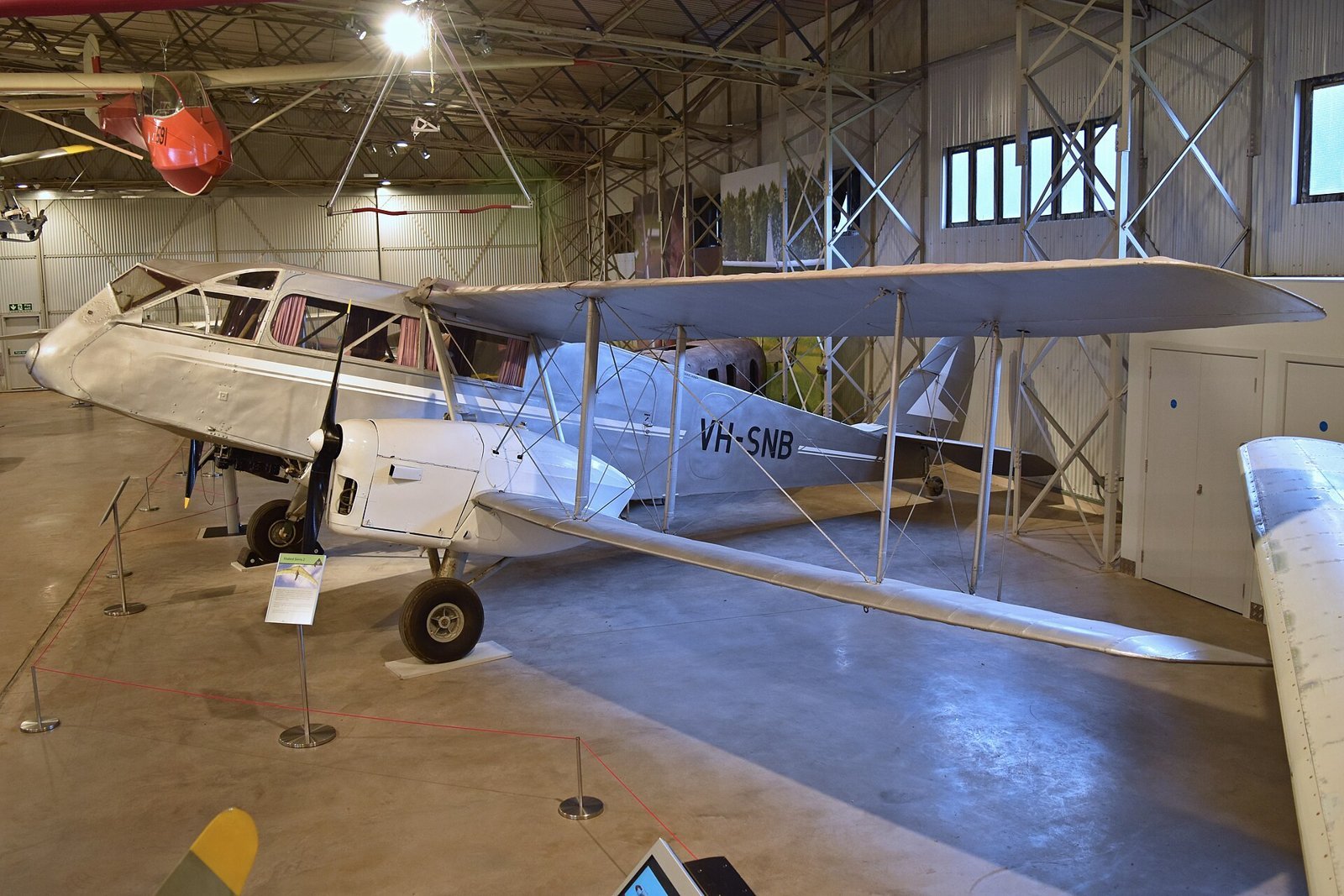
The very first Australian Dragon, A34-13, had a post-war career too. Goodall’s records show it was bought in 1946 by the Commonwealth Department of Health for the Northern Territory Medical Service in Darwin, and registered VH-ASK. As VH-SNB it later flew outback evangelical tours for Les Nixon’s “Australia’s Outback Patrol”, before heading to a private collection in Scotland in 1974. It was photographed on display at the National Museum of Flight in Scotland in 2017.
Where Can You See a Dragon Today?
Only a handful of Dragons survive, and just a few are airworthy. Here are some worth knowing about:
- RAAF Museum, Point Cook, Victoria. The museum’s collection includes Australian-built Dragon A34-92. Check the RAAF Museum website before you visit to see what’s on show.
- Aer Lingus’s Iolar (EI-ABI), Ireland. Kept flying by volunteers in honour of the airline’s first aircraft, and seen at airshows and events.
- G-ECAN, England. A wartime Australian-built Dragon (ex-RAAF A34-59), rebuilt to fly and seen at UK airshows such as Duxford’s Flying Legends.
If you spot a Dragon at an airshow, take a moment to listen to those two little Gipsy Majors. They’re the sound of a time when flying anywhere was still an adventure.
A Classic for Your Wall

If you love the golden age of biplanes as much as we do, you might like our “I’m Not Old, I’m a Classic” biplane poster. It’s a fun gift for a dad, grandad or pilot who’s still got plenty of flying left in them. You’ll find more vintage-aviation prints in our Art Shop.
Thanks for Flying With Us
The Dragon was never the fastest or the most glamorous aeroplane of its day, but it was cheap to run, tough enough for the outback and adaptable enough to do almost any job. It helped launch airlines, kept remote communities connected and carried patients to help. That’s a pretty good legacy for a plywood biplane.
Next month’s Classic Aircraft of the Month is the mighty Avro Lancaster. In the meantime, catch up on the North American P-51 WWII fighter and the golden age of biplanes.
Have you ever seen a Dragon fly, or flown in one? Tell us in the comments.
Build or display your own
The Dragon family is a natural for the shelf: the DH.84 that launched so many little airlines, and its bigger cousin the DH.89 Dragon Rapide. Airmodels has the Dragon itself plus RAF and USAAF Rapide markings.

de Havilland DH.84 Dragon (1/72 scale)

de Havilland DH.89 Dragon Rapide RAF (1/72 scale)

de Havilland DH.89 Dragon Rapide USAAF (1/72 scale)
About our links: this is an affiliate link, so PlanesNStuff may earn a small commission at no extra cost to you.
God bless you with blue skies!
