Tag: WWII trainers

  • The de Havilland Tiger Moth: Australia’s Most-Loved Training Biplane

    The de Havilland Tiger Moth: Australia’s Most-Loved Training Biplane

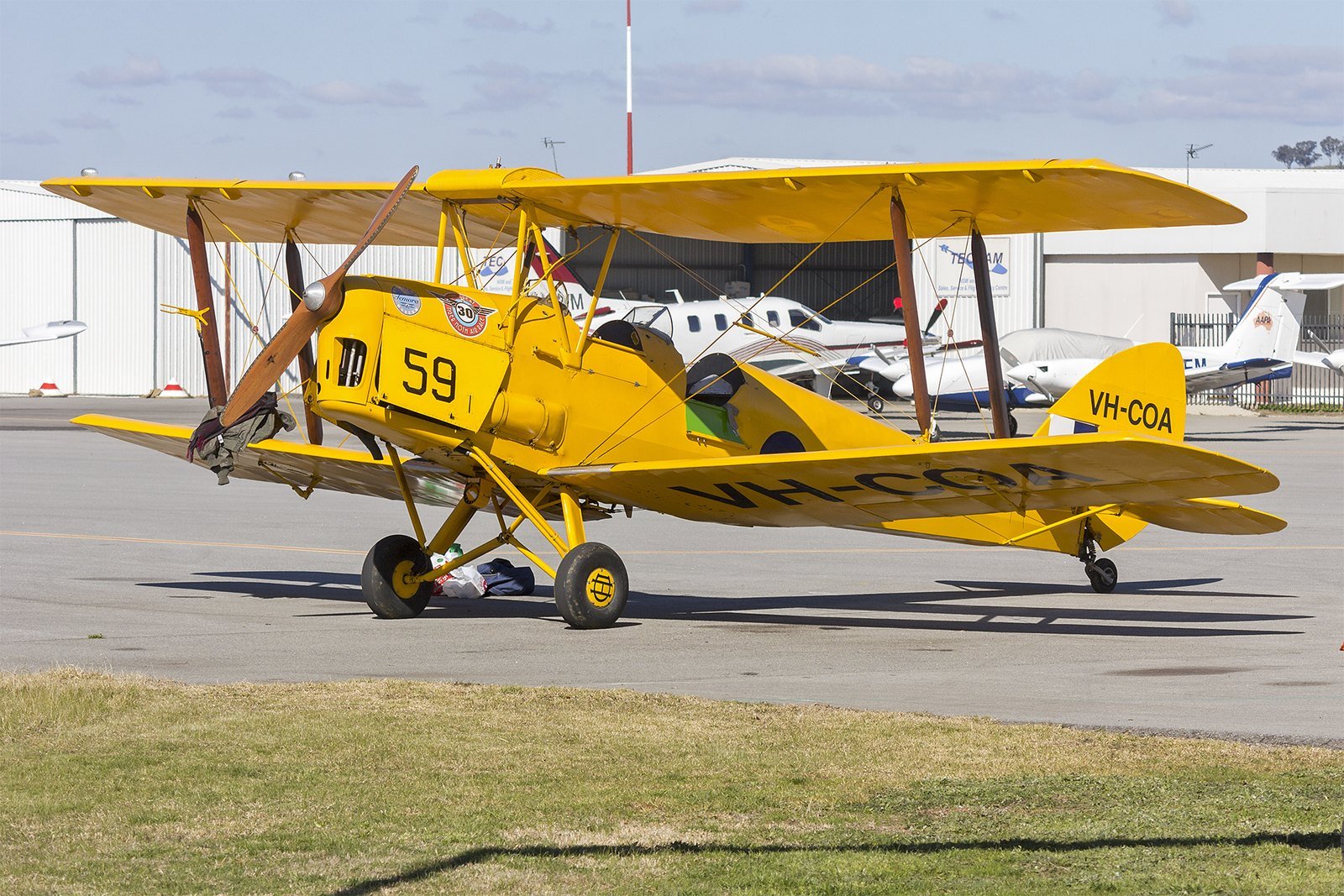
    Featured image: de Havilland Australia DH-82A Tiger Moth A17-759 (VH-COA) at Wagga Wagga Airport. Photo: Bidgee, CC BY-SA 3.0 AU, via Wikimedia Commons.

    Ninety-five years ago, on 26 October 1931, a little biplane called E6 lifted off from Stag Lane Aerodrome in Edgware, north London, with de Havilland’s chief test pilot Hubert Broad at the controls. It was the first true de Havilland DH.82 Tiger Moth, and it went on to teach tens of thousands of young people across the Commonwealth to fly.

    Here in Australia, the Tiger Moth isn’t just a famous old aeroplane. It’s our trainer. More than a thousand were built in Sydney, it served at flying schools from Tamworth to Western Junction, and you can still climb into an open cockpit and fly in one today.

    If you read our post on the Boeing-Stearman Kaydet, think of this as its Aussie twin. The Stearman taught America to fly. The Tiger Moth did the same job for Britain, Australia and much of the Commonwealth.

    From Moth to Tiger Moth

    Geoffrey de Havilland had already struck gold with the DH.60 Moth, a light biplane that put flying within reach of clubs and private owners. The Royal Air Force wanted a dedicated ab initio trainer (that’s a trainer for complete beginners), and de Havilland developed the DH.60T “Tiger” Moth into what became the DH.82, built to the Air Ministry’s Specification 15/31.

    One problem needed solving first. In the earlier Moths, the fuel tank and the struts holding up the top wing sat right above the front cockpit, which made it hard to get out in a hurry, especially wearing a parachute. De Havilland’s answer was neat: shift the top wing forward so the front seat was clear, then sweep the wings back slightly to keep the centre of lift in the right place. That gentle sweep is one of the easiest ways to pick a Tiger Moth from other biplanes of its era.

    A Few Clever Details

    • Differential ailerons. The ailerons are on the lower wing only, and they’re rigged to deflect mostly upwards and hardly at all downwards. That reduces adverse yaw, the tendency of the nose to swing away from a turn, though pilots still need some rudder in turns. The circular bell crank that drives them sits flush with the fabric under the lower wing.
    • A trainer that keeps you honest. Its big wings are forgiving and its stall and spin behaviour is benign, but it needs positive, prompt control movements. Some instructors liked that, because it helped weed out students who weren’t cut out for flying.
    • Simple to own and fly. It was cheap to own and maintain, and from late 1934 the improved DH.82A (the RAF’s Tiger Moth II) used the 130 hp (97 kW) de Havilland Gipsy Major engine.

    The RAF’s first Tiger Moths reached the Central Flying School in February 1932. Orders soon followed from more than 25 air forces.

    By the Numbers

    The DH.82A had a wingspan of 8.94 m (29 ft 4 in) and a top speed of about 175 km/h (109 mph). According to the RAAF, de Havilland and its partners built 8,811 Tiger Moths between 1931 and 1945, in seven countries.

    Made in Bankstown: The Australian Tiger Moth
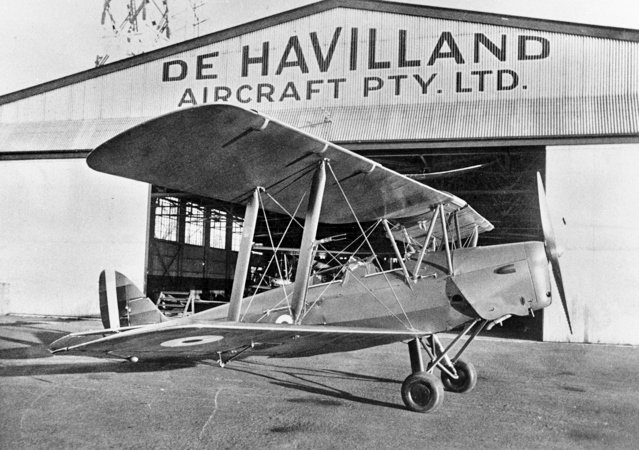
    Black-and-white photo of an RAAF Tiger Moth biplane parked outside the De Havilland Aircraft Pty. Ltd. hangar at Mascot in 1940
    Tiger Moth A17-32 outside the de Havilland Aircraft hangar at Mascot, Sydney, in 1940, just before delivery to the RAAF. Photo: Milton Kent, Australian War Memorial P02881.024, public domain, via Wikimedia Commons.

    De Havilland’s Australian company started small. In 1939 it delivered 20 Tiger Moths to the Royal Australian Air Force, assembled from imported fuselages with locally built wings. After war broke out, the RAAF chose the Tiger Moth as its primary trainer, and in 1940 de Havilland Australia began licence production at a new factory at Bankstown in Sydney. The first Australian-assembled Tiger Moth flew there in late 1940.

    By the time production ended in February 1945, 1,070 Tiger Moths had been built in Australia. Most went to the RAAF, but batches also went overseas, including 18 for the US Army Air Forces and 41 for the Royal Indian Air Force. Even the engines had an Aussie connection: Gipsy Major engines were built under licence in Australia by General Motors-Holden.

    Training a Generation: The Empire Air Training Scheme

    When the Second World War began, Britain worked out it needed about 50,000 new aircrew a year and could supply fewer than half of them itself. The answer was a joint training plan with Canada, Australia and New Zealand, signed on 17 December 1939. Here it was called the Empire Air Training Scheme, or EATS.

    Australia promised 28,000 aircrew over three years, about 36 per cent of the total. The first courses started on 29 April 1940. By the time the scheme wound up, more than 37,000 Australian airmen had trained under it.
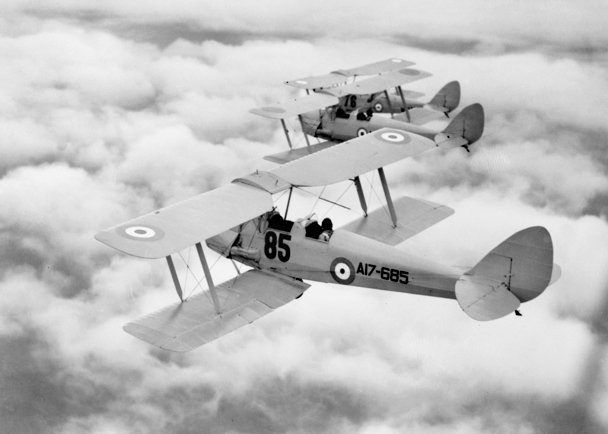
    Black-and-white photo of RAAF Tiger Moth trainers of No. 3 Elementary Flying Training School flying in formation above the clouds, 1941, led by A17-685
    Tiger Moths of No. 3 Elementary Flying Training School, Essendon, flying above the clouds in April 1941. Photo: John Harrison, Australian War Memorial AC0101, public domain, via Wikimedia Commons.

    For would-be pilots, the first stop was one of 12 Elementary Flying Training Schools (EFTS), from Parafield and Archerfield to Narromine, Narrandera, Temora, Benalla, Cunderdin and Western Junction in Tasmania. The aircraft was almost always the Tiger Moth. Trainees aimed to go solo after about seven to ten hours, then kept going with instrument flying, navigation, night flying and aerobatics before moving on to service flying school.

    It’s worth remembering what that meant. Many of the young people who learned to fly in a Tiger Moth over a country town went on to serve in Europe, the Middle East and the Pacific, and not all of them came home.

    A Long Retirement (That Never Quite Happened)

    The RAF replaced its Tiger Moths with the de Havilland Chipmunk in the early 1950s, and surplus aircraft poured onto the civil market. In Australia they became the backbone of aero clubs, flying schools and private hangars.

    The RAAF’s own history of Tiger Moth A17-692 sums up the type’s working life. It trained pilots at No. 5 EFTS Narromine and No. 10 EFTS Temora during the war, then went to the Royal Australian Navy at HMAS Albatross, where it served until 1958. It may well have been the last Tiger Moth operated by the Australian military. Today it belongs to the RAAF Museum, and in 2023 it went to Luskintyre in NSW for a refurbishment before returning to the air with No. 100 Squadron.

    Then there’s A17-691. As VH-UVZ it was only the second DH.82A imported into Australia, registered in August 1936. On 21 April 1937 it crashed into Sydney Harbour, and remarkably, it was recovered and flew again. In August 1940 it was impressed into the RAAF as A17-691 and served at No. 10 EFTS Temora. In December 2000 it was donated to the Temora Historic Flight, and it’s now part of the RAAF’s heritage fleet.

    Where to See a Tiger Moth in Australia

    • RAAF Museum, Point Cook, Victoria: Home of A17-692 and No. 100 Squadron, which flies heritage aircraft at the museum. Flying isn’t scheduled on every open day, so contact the museum to check before you go (bookings and photo ID are needed to enter the base).
    • Temora Aviation Museum, NSW: Houses the RAAF No. 100 Squadron Historic Flight collection, including Tiger Moth A17-691. The museum is open daily, but it says no flying displays are scheduled there in 2026 or 2027, so check its Facebook page for where the aircraft will appear.
    • Australian War Memorial, Canberra: Holds Tiger Moth A17-704, built in 1943, which served with No. 1 EFTS at Tamworth.
    • Mackay Tiger Moth Museum, Queensland: Formed in 1974 (as the Tiger Moth Trust) to buy a locally restored Tiger Moth that was in danger of being sold to America. Its hangar beside the Mackay Aero Club is open most Saturday and Sunday mornings, weather permitting.

    Where to Fly in a Tiger Moth

    Nothing beats the real thing: leather helmet, goggles, wind in the wires and a Gipsy Major ticking over in front of you. These operators each list Tiger Moth joy flights on their own websites:

    • Royal Newcastle Aero Club, Maitland, NSW: A DH-82 Tiger Moth restored in the club’s own workshop, with flights over the Hunter Valley, Pokolbin vineyards, Luskintyre and Newcastle.
    • Tiger Moth Joy Flights Yarra Valley, Lilydale, Victoria: Scenic and aerobatic flights over the Yarra Valley in DH-82A Tiger Moth VH-DHR, about an hour from Melbourne.
    • Mackay Tiger Moth Museum, Queensland: Joy flights in one of its two Tiger Moths along the Mackay coast (longer flights also cross the cane fields), most weekends.

    Operators set their own age, height and weight limits, and every flight depends on the weather. Check each operator’s website for current details and prices before you book. A Tiger Moth flight also makes a pretty special gift for the aviation lover in your life.

    A Classic for Your Wall
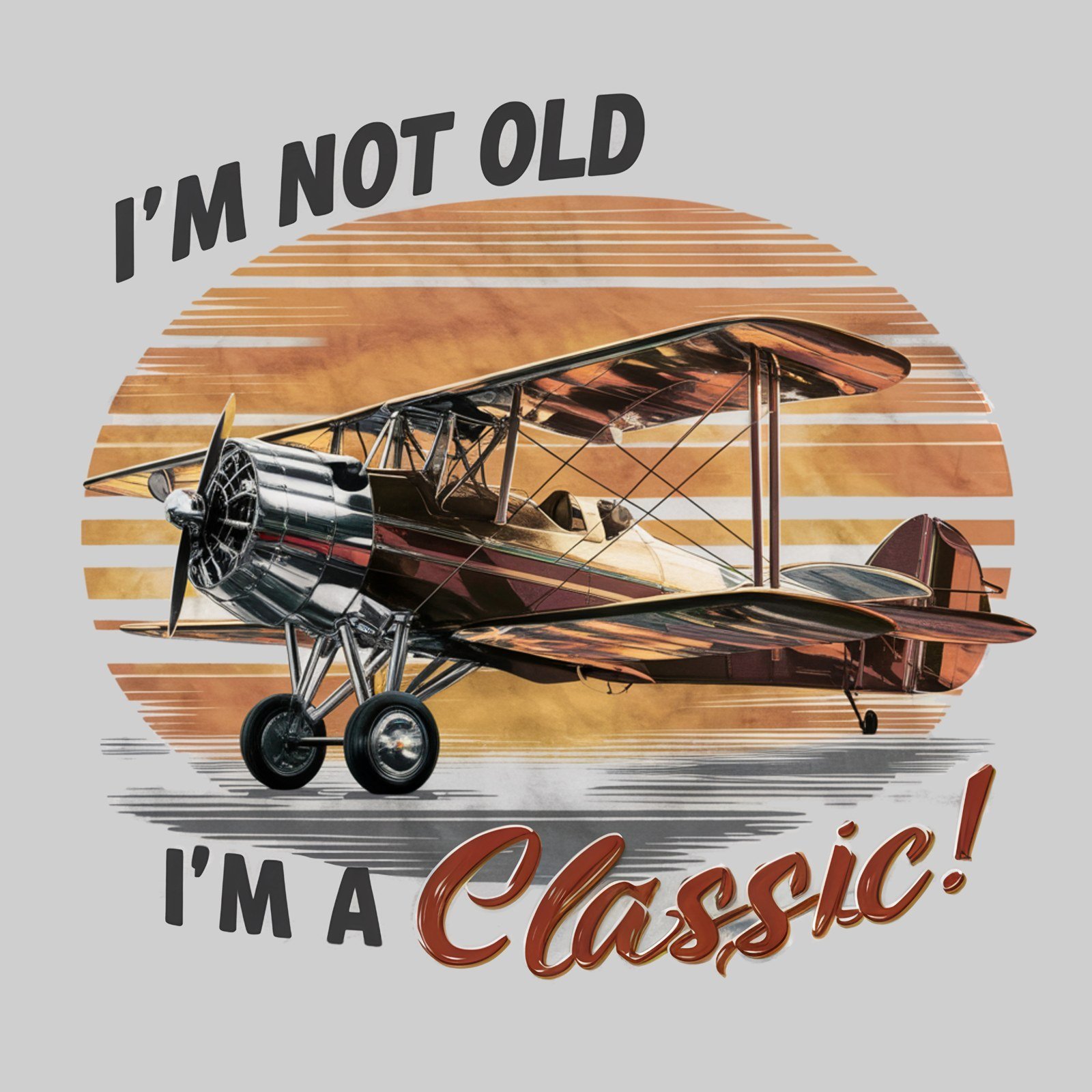
    Poster of a polished chrome vintage biplane in front of a striped orange retro sunset, with the words I'm Not Old, I'm a Classic!
    Our “I’m Not Old, I’m a Classic” biplane poster, available on Etsy. I created it with the help of AI image tools.

    Ninety-five years old and still flying: if any aeroplane has earned the right to say “I’m not old, I’m a classic”, it’s the Tiger Moth. That “still going strong” spirit is exactly why we love our “I’m Not Old, I’m a Classic” biplane poster. It’s a polished chrome vintage biplane in front of a retro striped sunset, and it makes a fun gift for the pilot, aero club member or birthday legend in your life who’s proudly a classic themselves.

    And if you prefer your biplanes from the other side of the Pacific, our Stearman Biplane in Flight print is the Tiger Moth’s American cousin, in blue and yellow.

    Thanks for Flying With Us

    Ninety-five years on, the Tiger Moth is still doing what it does best: putting a grin on the face of anyone who flies in one. Have you flown in a Tiger Moth, or did someone in your family train in one during the war? We’d love to hear the story.

    God bless you with blue skies!

  • The Boeing-Stearman Kaydet: The Biplane That Taught America to Fly

    The Boeing-Stearman Kaydet: The Biplane That Taught America to Fly

    Ask a World War II pilot what they first learned to fly in, and there’s a good chance the answer is “a Stearman.” Officially it was the Kaydet. Hardly anyone called it that. To the cadets who sweated through primary training in its open cockpits, it was simply the Stearman.

    In our first post we looked at the golden age of biplanes. Now we’re taking a closer look at one of the best-loved of them all: the Boeing-Stearman Model 75.

    From Kansas Roots: Lloyd Stearman and Stearman Aircraft

    The story begins with Lloyd Stearman, born in Wellsford, Kansas, in 1898. He learned to fly with the U.S. Naval Reserve in 1918. In 1925 he teamed up with Walter Beech and Clyde Cessna to form the Travel Air Manufacturing Company. (Yes, those Beech and Cessna names became famous on their own.)

    In 1926 Stearman struck out on his own, founding Stearman Aircraft in California. He moved the company back to Wichita, Kansas, in 1927. There, Stearman biplanes included mail planes for early airlines such as Varney Air Lines.

    Boeing Comes Aboard

    In 1929 Stearman Aircraft became part of United Aircraft and Transport Corporation, the group that also included Boeing. Lloyd Stearman himself resigned in 1931. After a 1934 reorganization, Stearman became a division of Boeing. In 1941 it was renamed Boeing’s Wichita Division.

    So who designed the famous trainer? In late 1933, Stearman engineers Mac Short, Harold Zipp and Jack Clark took a 1931 Lloyd Stearman design and developed it into the Model 70. It first flew on January 1, 1934. Refined through the Model 73 and the X75, it caught the eye of the U.S. Army Air Corps, which ordered its first batch in 1935.

    PT-13, PT-17, PT-18 and N2S: Decoding the Variants

    The Model 75 wore several military designations, and for the Army, the designation mostly told you which radial engine was up front:

    • PT-13 series: Lycoming R-680 engine. This was the original Army Kaydet.
    • PT-17: Continental R-670-5, a seven-cylinder radial rated at 220 hp. This was the most-delivered Army version, with 2,942 built.
    • PT-18: Jacobs R-755. Only 150 were built, because the engines were needed for other trainers.
    • PT-27: The paperwork designation for 300 aircraft supplied to the Royal Canadian Air Force under Lend-Lease. The Canadians called it the Kaydet.

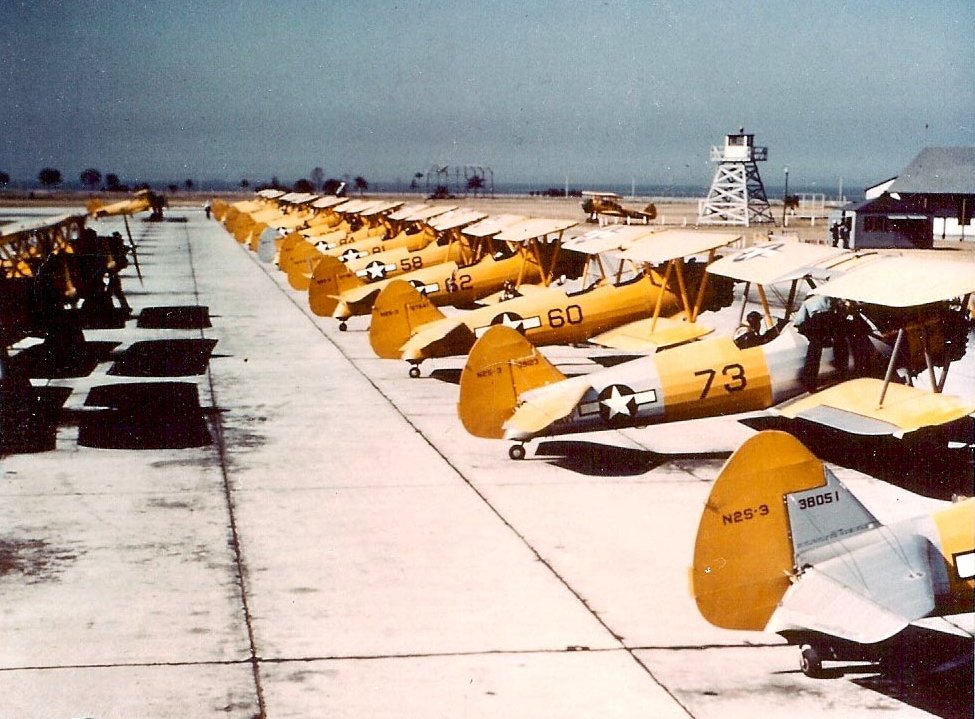
    The U.S. Navy bought its own versions as the NS and N2S, with N2S-1 through N2S-5 models using Continental or Lycoming engines. Painted overall yellow, Navy primary trainers earned the nickname “Yellow Peril”.

    A long line of yellow U.S. Navy N2S-3 Stearman biplane trainers parked on a concrete ramp at a Naval Air Station
    U.S. Navy N2S-3 Kaydet trainers at a stateside Naval Air Station, c. 1943–1945. Photo: U.S. Navy, public domain, via Wikimedia Commons.

    One neat detail: the Boeing-Stearman E75 was the only Army and Navy production design to be completely standardized during World War II. It served the Army as the PT-13D and the Navy as the N2S-5.

    By the Numbers

    A typical PT-17 had a wingspan of 32 ft 2 in (9.80 m) and a top speed of around 124 mph (200 km/h). The Smithsonian says Boeing’s Wichita Division built more than 10,000 Stearman trainers. Boeing’s own figure of 10,346 includes spare parts counted as aircraft, while one airframe count puts the number of complete Model 70s, 75s and 76s at 8,584. Whichever number you use, it’s one of the most-produced biplanes ever built.

    The Backbone of WWII Primary Training

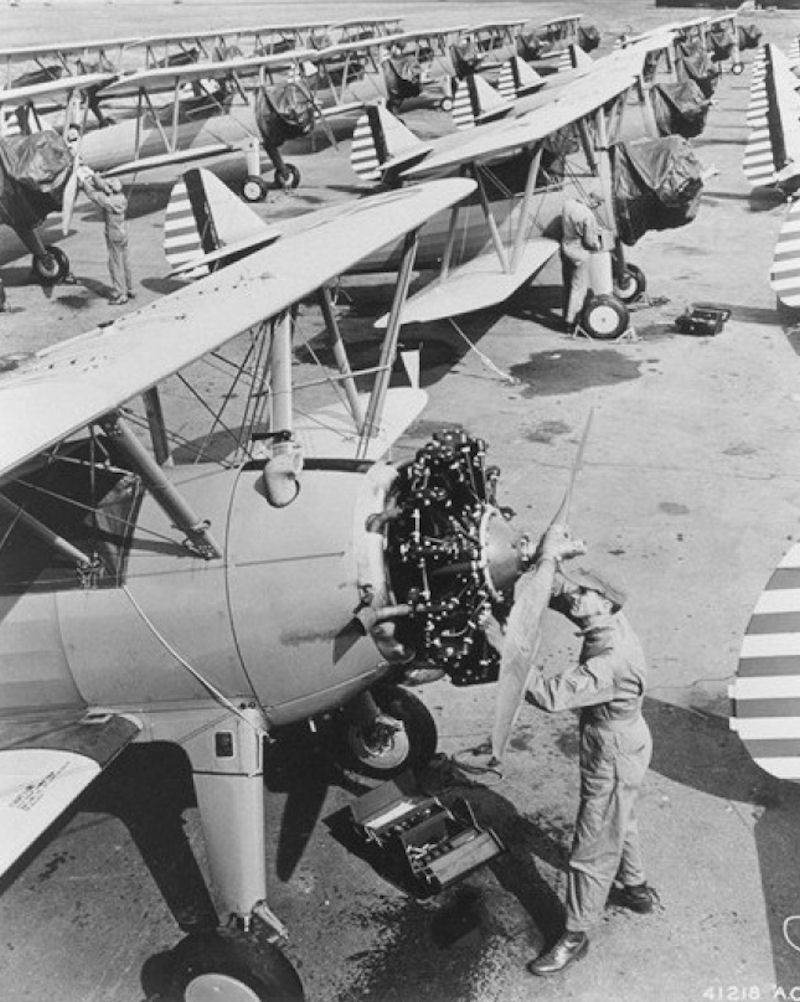
    When the U.S. built up its air forces before and during World War II, it needed tens of thousands of new pilots, fast. Primary training meant a cadet’s first real flying, and the Stearman, along with Fairchild and Ryan trainers, became the backbone of Army and Navy primary training.

    The Stearman suited the job. It was rugged, with a big, fixed tailwheel landing gear and tandem open cockpits for student and instructor. The National Naval Aviation Museum describes it as reliable, simple, durable and forgiving. Still, as a taildragger it demanded real attention on takeoff and landing, and that was exactly the kind of discipline future combat pilots needed.

    Famous Cadets

    • George H. W. Bush: In January 1943, Aviation Cadet George H. W. Bush made two flights in N2S-3 Bureau Number 05369 at Naval Air Station Minneapolis. That exact aircraft is now displayed at the National Naval Aviation Museum in Pensacola, Florida. Logbooks show five surviving N2S-3s that he flew in training.
    • The Tuskegee Airmen: At Moton Field in Tuskegee, Alabama, African American cadets trained for Army Air Forces service. One of their PT-13D trainers, the Spirit of Tuskegee, now belongs to the Smithsonian’s National Museum of African American History and Culture in Washington, D.C. Its baggage compartment door is signed by 36 former Tuskegee Airmen.

    A Second Career: Crop Dusters and Airshow Stars

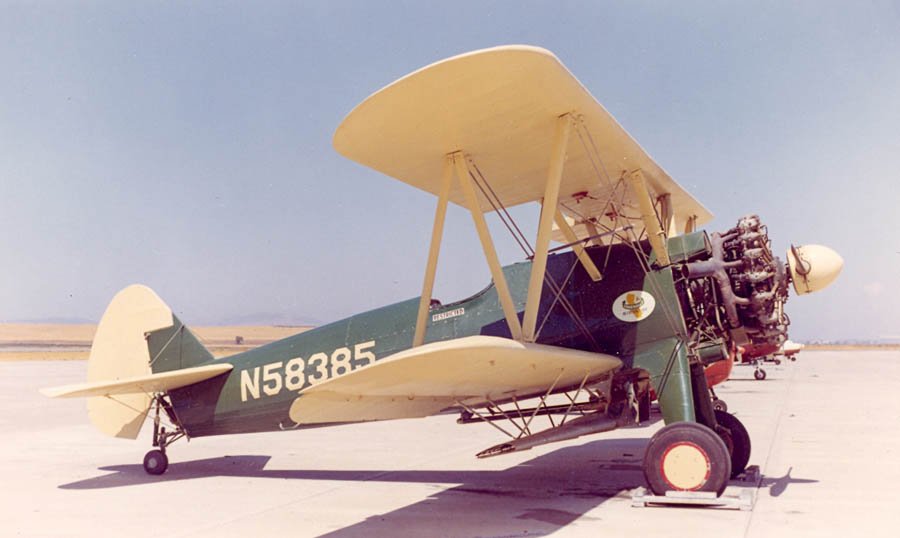
    After the war, thousands of surplus Stearmans were sold to civilians. Many became crop dusters. The front cockpit was replaced with a hopper for chemicals or fertilizer, and spray bars were fitted under the lower wings. A popular upgrade swapped in a more powerful Pratt & Whitney R-985 Wasp Junior engine. By one count, more than 4,345 Stearmans were working in agricultural flying in 1948. Even the Bush N2S at Pensacola spent part of its postwar life as a crop duster.

    Green and cream Stearman biplane crop duster, registration N58385, with spray equipment under the lower wing, parked on an airport ramp
    A Stearman crop duster, registration N58385. Photo: Bill Larkins, CC BY-SA 2.0, via Wikimedia Commons.

    The Stearman’s strength and big, stable wings also made it a natural for air shows, aerobatics and wing walking. In the UK, the AeroSuperBatics wingwalking team flies a team of Boeing Stearmans fitted with 450-hp radial engines. Their wingwalkers perform strapped to the top wing.

    Why Pilots and Fans Love the Stearman

    • It looks the part. Blue fuselage, yellow wings, star roundels, striped rudder. It’s the classic image of a biplane.
    • That radial sound. An uncowled radial engine has a rumble you feel in your chest.
    • It’s honest. Like the best trainers, it rewards good flying and lets you know when you’ve done it badly.
    • It’s living history. Many surviving Stearmans trained real cadets who went on to serve.

    That “old but still brilliant” spirit is exactly why we love our “I’m Not Old, I’m a Classic” biplane poster. It’s a fun nod to every proud vintage model out there, with or without wings.

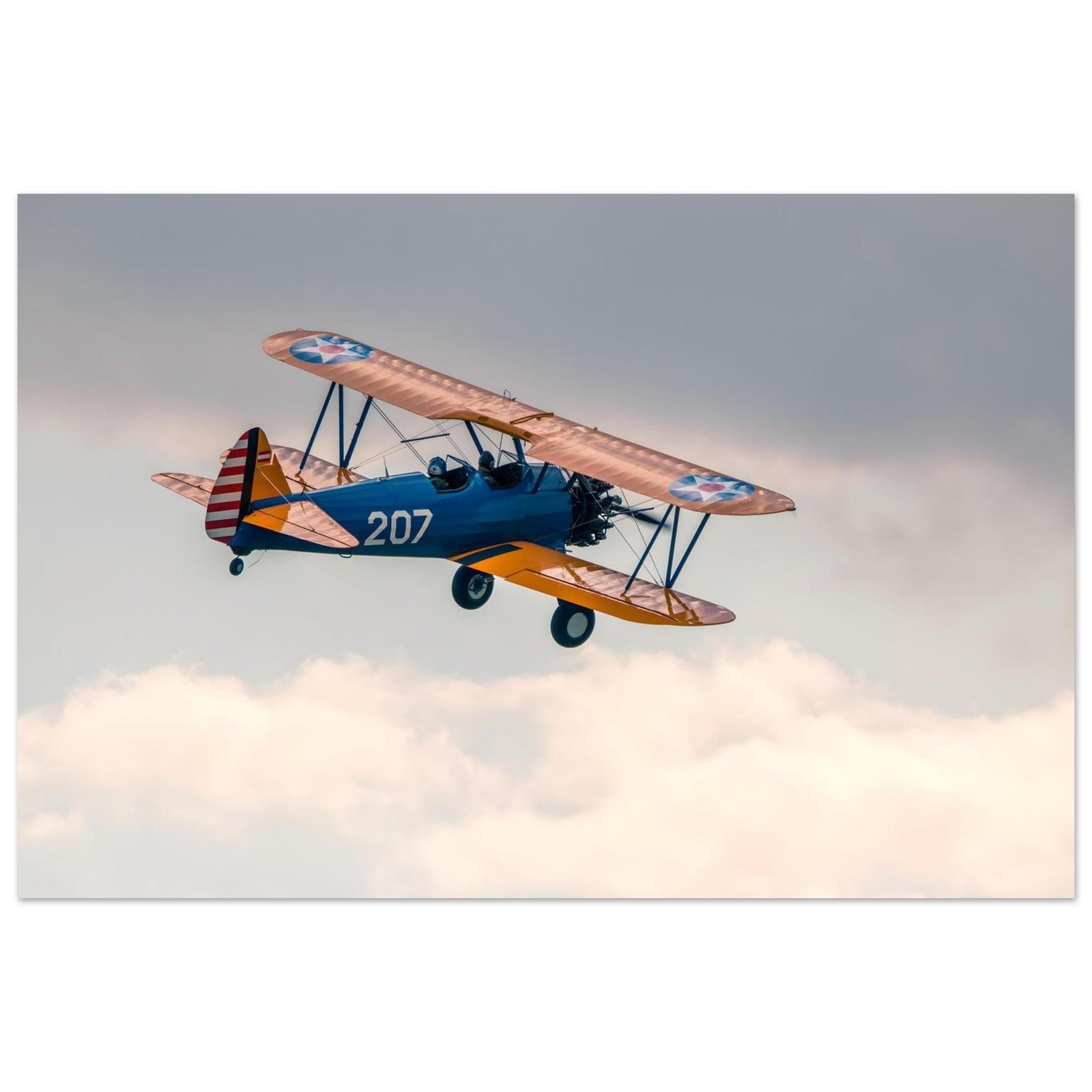
    And if you love the Stearman as much as we do, our Stearman Biplane in Flight print captures a blue and yellow Kaydet climbing above the clouds. It’s available as a printed poster or an instant digital download.

    Stearman biplane art print: a blue and yellow Boeing-Stearman Kaydet, number 207, flying above the clouds
    Stearman Biplane in Flight, available as a poster or digital download on Etsy.

    Where to See a Stearman in the U.S.

    Museums

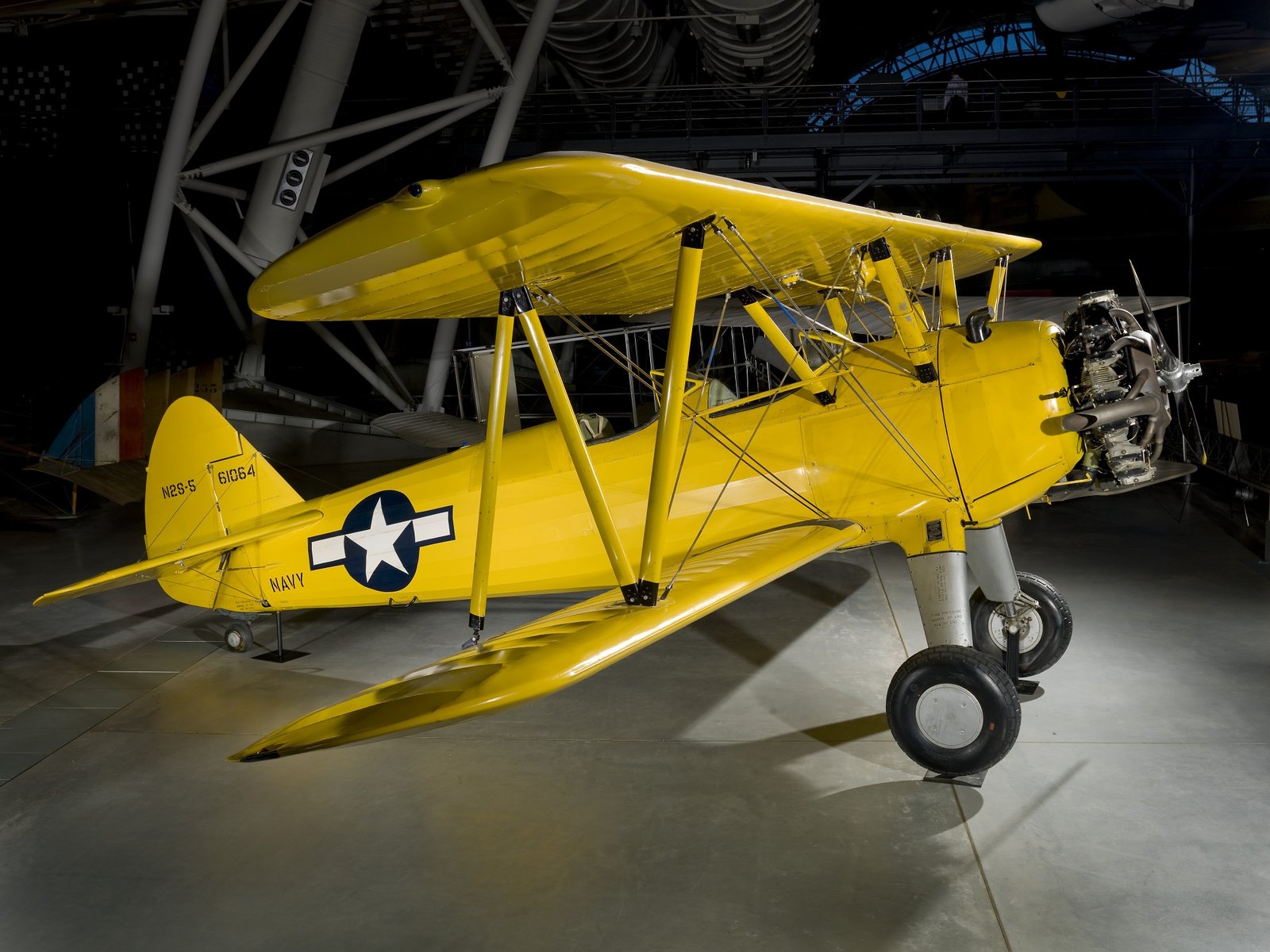
    Yellow Boeing-Stearman N2S-5 Kaydet biplane, Navy number 61064, on display inside a museum hangar
    Boeing-Stearman N2S-5 Kaydet 61064 at the Smithsonian’s Steven F. Udvar-Hazy Center. Image: Smithsonian National Air and Space Museum, CC0, via Wikimedia Commons.

    The National Stearman Fly-In

    Every September, Stearman owners gather in Galesburg, Illinois, for the National Stearman Fly-In. In 2026, the 55th event ran September 7–12 at Galesburg’s airport. It included formation flying, aerobatic and flour-bombing contests, and public community days. Check the official site for next year’s dates.

    Where to Fly in a Stearman

    Several operators offer open-cockpit Stearman rides. Each one below is listed on its own website:

    Rides are usually one passenger at a time, and operators set their own age, weight and weather rules. Check each operator’s site for current details before you book.

    Want more? Follow PlanesNStuff on YouTube for aviation Shorts.

    Watch: The Biplane That Taught America to Fly

    Thanks for Flying With Us

    The Stearman taught a generation to fly, then went right on working, playing and inspiring. That’s quite a résumé for a biplane designed in the early 1930s.

    God bless you with blue skies!