Watch a fully loaded airliner lift off and it’s hard not to wonder: how do planes fly? You don’t need a single equation to understand it, and once it clicks you’ll see it everywhere, from paper planes and RC trainers to helicopter rotors and drone props.
The Four Forces: Lift, Weight, Thrust and Drag
Every aircraft in flight is pushed and pulled by four forces:
- Lift holds it up. Most of it comes from the wings, and it acts at right angles to the flight path.
- Weight is gravity pulling down on the aircraft, fuel, people and cargo. It drops as fuel is burned.
- Thrust is the forward push from the propeller, jet engine or rotor.
- Drag is the air resisting the aircraft’s motion.
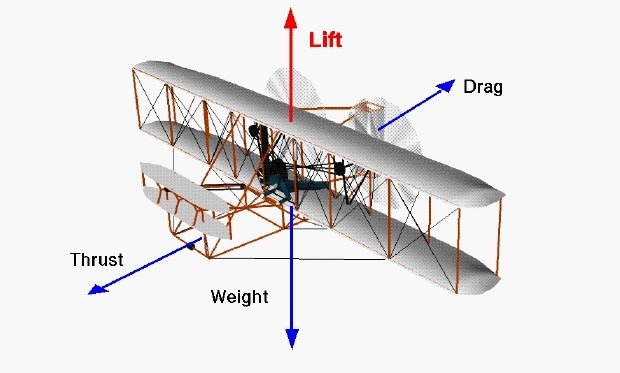
In steady, level flight, lift balances weight and thrust balances drag. As the FAA’s Pilot’s Handbook of Aeronautical Knowledge points out, that doesn’t make all four equal: lift and weight are bigger than thrust and drag.
Surprisingly, the engines don’t hold the plane up. As NASA puts it, the engine’s job is to overcome drag, and the wings do the lifting. Most gliders have no engine at all and fly just fine.
So How Does a Wing Make Lift?
NASA’s Glenn Research Center sums it up in one line: lift happens when a moving flow of air is turned by a solid object. A wing meeting the air at a slight angle turns the passing air downwards, and by Newton’s third law (every action has an equal and opposite reaction) the air pushes the wing up. Both the top and bottom surfaces help turn the flow.
You can describe the same thing with pressure. The air speeds up over the top of a lifting wing, and faster-moving air has lower pressure. So the pressure on top ends up lower than underneath, and that difference, added up across the whole wing, is lift.
Bernoulli or Newton? Yes.
People have argued for years over whether lift is “really” Bernoulli (pressure difference) or “really” Newton (air pushed down). NASA’s answer: both are correct. They’re two ways of adding up the same flow, and they give the same force. Neither man ever tried to explain lift, by the way. Newton presented his laws of motion in 1686 and Bernoulli published Hydrodynamica in 1738, long before anyone flew.
How much lift a wing makes depends on its shape and size, its angle to the air, the air’s density and, above all, speed. Lift grows with the square of speed. The FAA’s example: an aeroplane at 370 km/h (200 knots) has four times the lift it has at 185 km/h (100 knots), all else being equal.
Busting the “Equal Transit Time” Myth
You may have learned this at school: the top of a wing is longer, so air going over it must hurry to meet the air from underneath at the back edge. NASA Glenn calls it one of the most widely circulated incorrect explanations of lift:
- Nothing makes the air meet up. Air over the top actually moves much faster than the theory says and reaches the trailing edge first.
- The numbers don’t work. The theory’s speeds predict far less lift than real wings produce.
- Equal-length wings fly. A paper plane’s wing is a flat sheet. The Wright brothers’ wings were thin curved plates, the same distance over the top and underneath.
- Aeroplanes fly upside down. Flip the wing and the “longer path” is on the bottom, yet aerobatic pilots do it at airshows all the time.
The faster air and lower pressure on top are real; it’s the reason that was wrong. (We met the 1903 Flyer in our Golden Age of Biplanes post.)
Angle of Attack: The Secret Ingredient
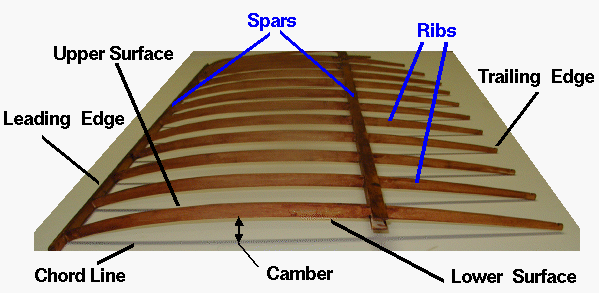
Draw a straight line from the front edge of a wing to the back edge: that’s the chord line. The angle between it and the oncoming air is the angle of attack, the pilot’s main lever on lift.
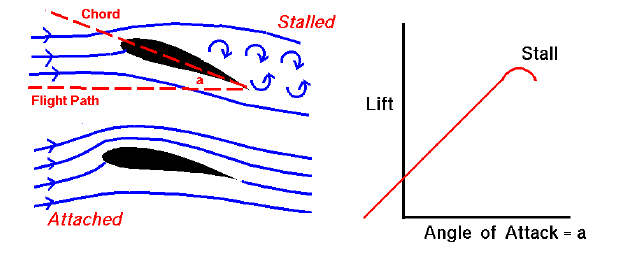
At small angles (up to about 10 degrees), NASA says lift rises almost in step with angle of attack. That’s why a pilot raises the nose just before lifting off the runway. It’s also why a slower aeroplane needs a higher angle of attack to make the same lift. A curved (cambered) aerofoil, or “airfoil” in US spelling, makes some lift even at zero angle. A symmetrical one needs tilting first.
Stalls: When the Air Lets Go
Raise the angle too far and the air over the top can no longer follow the wing’s curve. It breaks away from the surface, and lift drops off sharply. That’s a stall.
- It’s not the engine. A stall is all about airflow over the wing.
- It’s an angle, not a speed. The FAA says each aircraft stalls at one critical angle of attack, roughly 16 to 20 degrees depending on the design, whatever its speed or weight. So you can stall at any airspeed.
- The fix is less angle. Most training aircraft are designed so the nose drops in a stall, which lowers the angle of attack and lets the air flow smoothly again.
Flaps: Extra Lift for Slow Flying
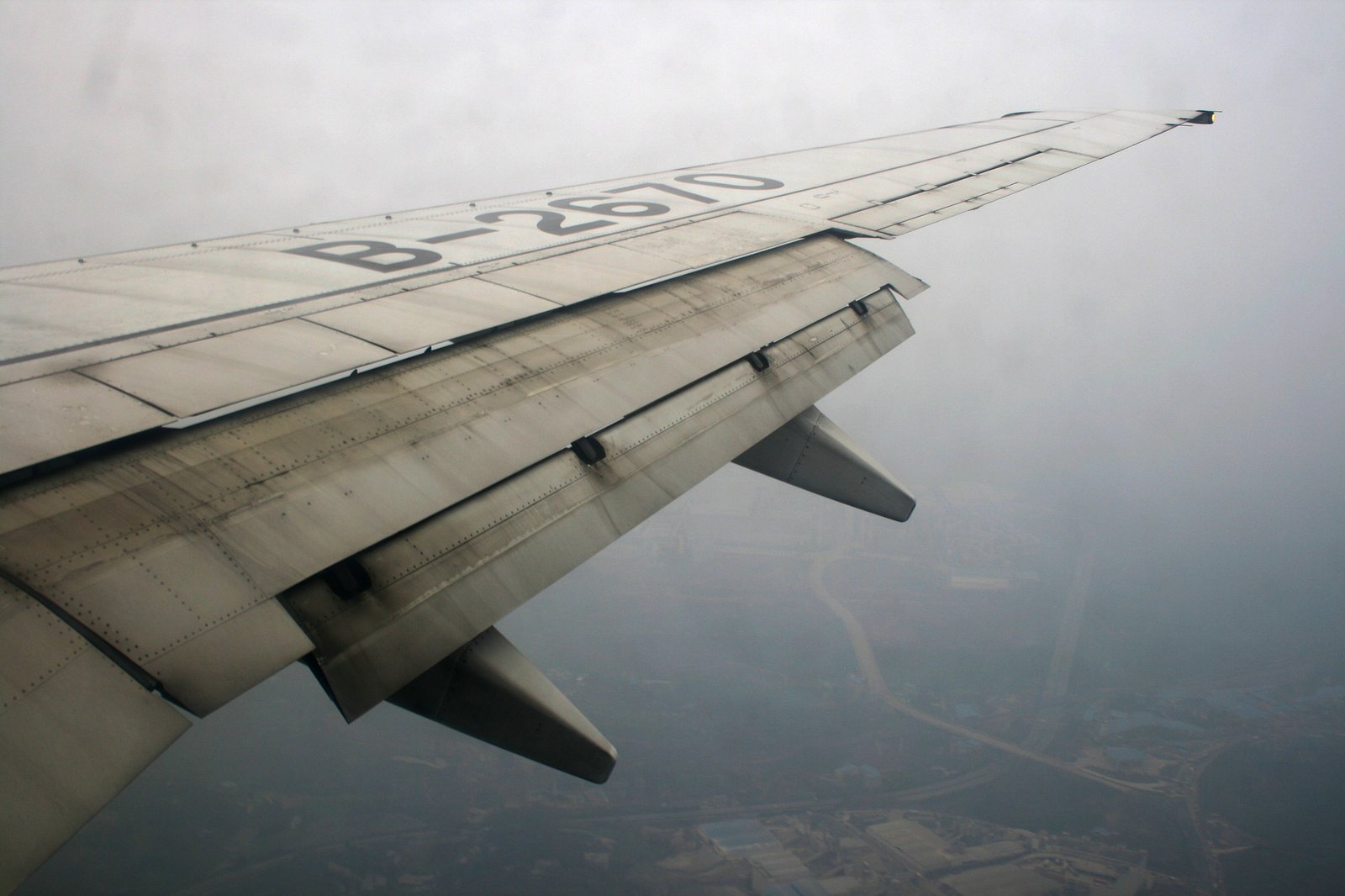
Fast cruising and slow landing want different wings, and flaps let one wing do both. Extended from the trailing edge, they increase lift (and drag) at any given angle of attack. The FAA lists four common types: plain, split, slotted and Fowler. Fowler flaps slide backwards on tracks before angling down, adding wing area as well as curve.
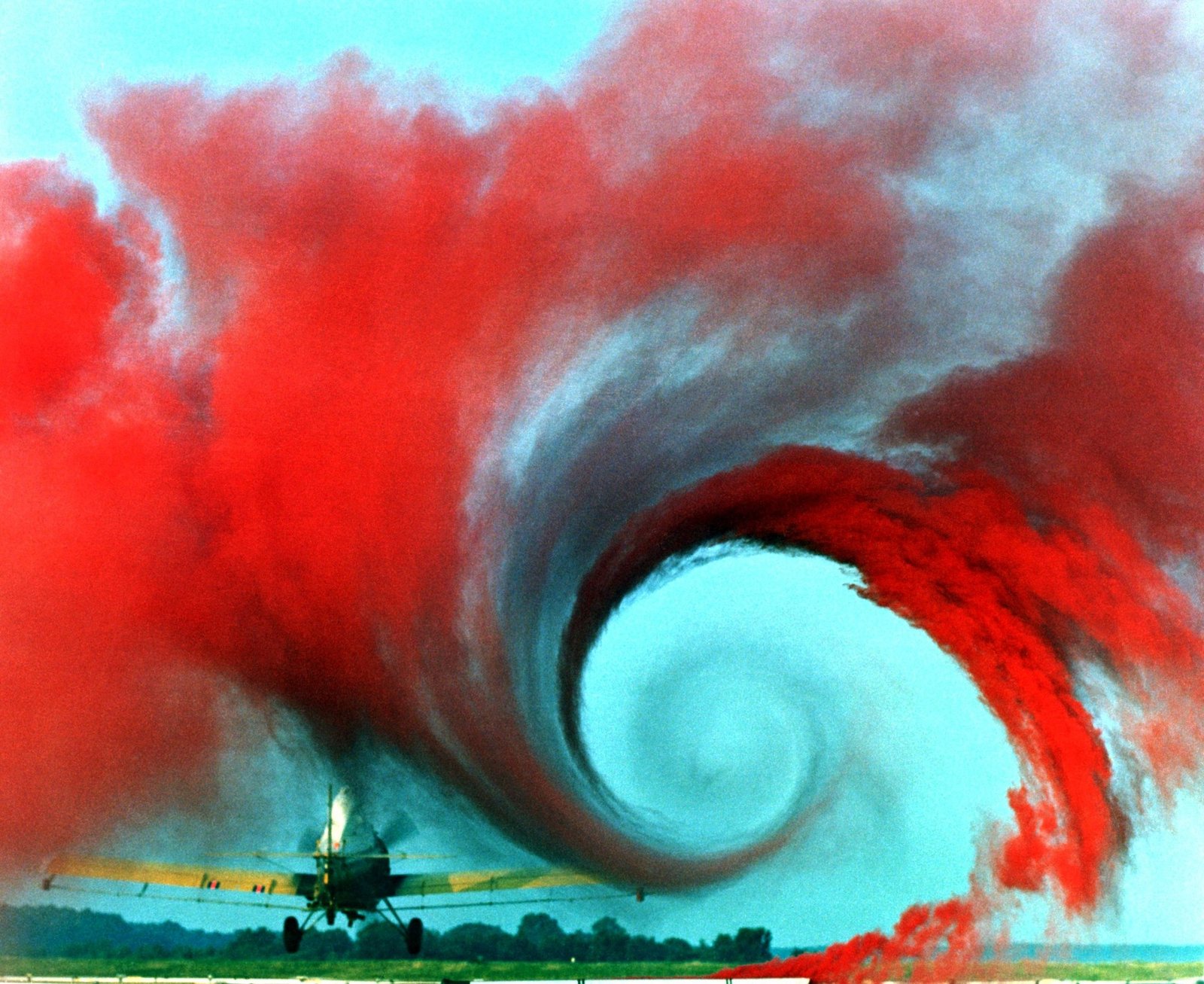
The swirling smoke in our header photo shows another side effect of lift. Air spills from the high-pressure underside around each wingtip into the low pressure on top, rolling up into a wingtip vortex. The FAA says these are strongest when an aircraft is “heavy, clean, and slow”.
Same Physics, Smaller Scale: RC Planes, Helicopters and Drones
The FAA says the four forces act on all aircraft, backyard ones included.
- RC planes: a foam trainer’s wing turns the air just like an airliner’s, and if you fly it too slowly with too much up-elevator, it will stall too.
- Propellers: NASA describes a propeller as being like a rotating wing. Each blade has an aerofoil cross-section and is twisted, because the tip moves faster than the hub.
- Helicopters: the rotor blades are spinning wings. Raising the collective increases the pitch of all the blades at once, and so their angle of attack. The spinning rotor also tries to turn the body the other way, which is why there’s a tail rotor.
- Drones: NASA’s quadcopter guide explains that the props push air down and the reaction lifts the drone, which hovers when lift equals weight. Speeding up the props on one side tilts it so part of the lift pushes it sideways. Two props spin clockwise and two anticlockwise, so their twisting forces cancel.
Try It Yourself
- Paper plane: throw a simple dart gently and level, then nose-up. The nose-high throw slows, stalls and drops.
- Hand out the window: only as a passenger, at low speed on a quiet road, with the driver’s OK and nothing nearby. Tilt the front of your flat hand up slightly and feel it rise. If in doubt, stick to the paper plane.
- In your flight sim: in a light trainer, slow down gently in level flight with flaps up and note the speed when the stall warning sounds. Repeat with full flap and you should be able to fly slower. Lower the nose to recover.
- NASA’s free simulator: the Student Airfoil Interactive lets you change angle, speed and wing shape and watch the lift change.
Thanks for Flying With Us
So, how do planes fly? The wing turns the air down, the pressure on top drops, and up you go. Angle of attack is the dial, a stall is turning it too far, and flaps add lift for landing. Same physics for an airliner, a Tiger Moth or a palm-sized drone.
The Wright brothers’ wings were turning the air in 1903, and good design never goes out of style. That’s the whole idea behind our “I’m Not Old, I’m a Classic” biplane poster.
Want more? Follow PlanesNStuff on YouTube for aviation Shorts. God bless you with blue skies!
