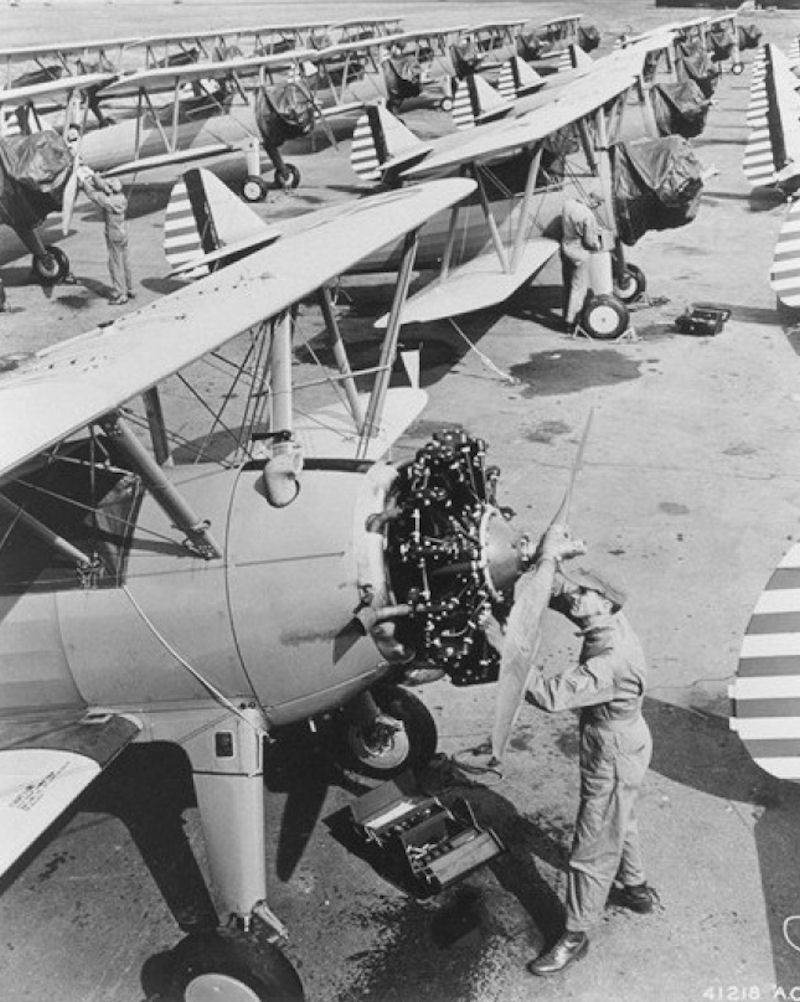
Ask a World War II pilot what they first learned to fly in, and there’s a good chance the answer is “a Stearman.” Officially it was the Kaydet. Hardly anyone called it that. To the cadets who sweated through primary training in its open cockpits, it was simply the Stearman.
In our first post we looked at the golden age of biplanes. Now we’re taking a closer look at one of the best-loved of them all: the Boeing-Stearman Model 75.
From Kansas Roots: Lloyd Stearman and Stearman Aircraft
The story begins with Lloyd Stearman, born in Wellsford, Kansas, in 1898. He learned to fly with the U.S. Naval Reserve in 1918. In 1925 he teamed up with Walter Beech and Clyde Cessna to form the Travel Air Manufacturing Company. (Yes, those Beech and Cessna names became famous on their own.)
In 1926 Stearman struck out on his own, founding Stearman Aircraft in California. He moved the company back to Wichita, Kansas, in 1927. There, Stearman biplanes included mail planes for early airlines such as Varney Air Lines.
Boeing Comes Aboard
In 1929 Stearman Aircraft became part of United Aircraft and Transport Corporation, the group that also included Boeing. Lloyd Stearman himself resigned in 1931. After a 1934 reorganization, Stearman became a division of Boeing. In 1941 it was renamed Boeing’s Wichita Division.
So who designed the famous trainer? In late 1933, Stearman engineers Mac Short, Harold Zipp and Jack Clark took a 1931 Lloyd Stearman design and developed it into the Model 70. It first flew on January 1, 1934. Refined through the Model 73 and the X75, it caught the eye of the U.S. Army Air Corps, which ordered its first batch in 1935.
PT-13, PT-17, PT-18 and N2S: Decoding the Variants
The Model 75 wore several military designations, and for the Army, the designation mostly told you which radial engine was up front:
- PT-13 series: Lycoming R-680 engine. This was the original Army Kaydet.
- PT-17: Continental R-670-5, a seven-cylinder radial rated at 220 hp. This was the most-delivered Army version, with 2,942 built.
- PT-18: Jacobs R-755. Only 150 were built, because the engines were needed for other trainers.
- PT-27: The paperwork designation for 300 aircraft supplied to the Royal Canadian Air Force under Lend-Lease. The Canadians called it the Kaydet.
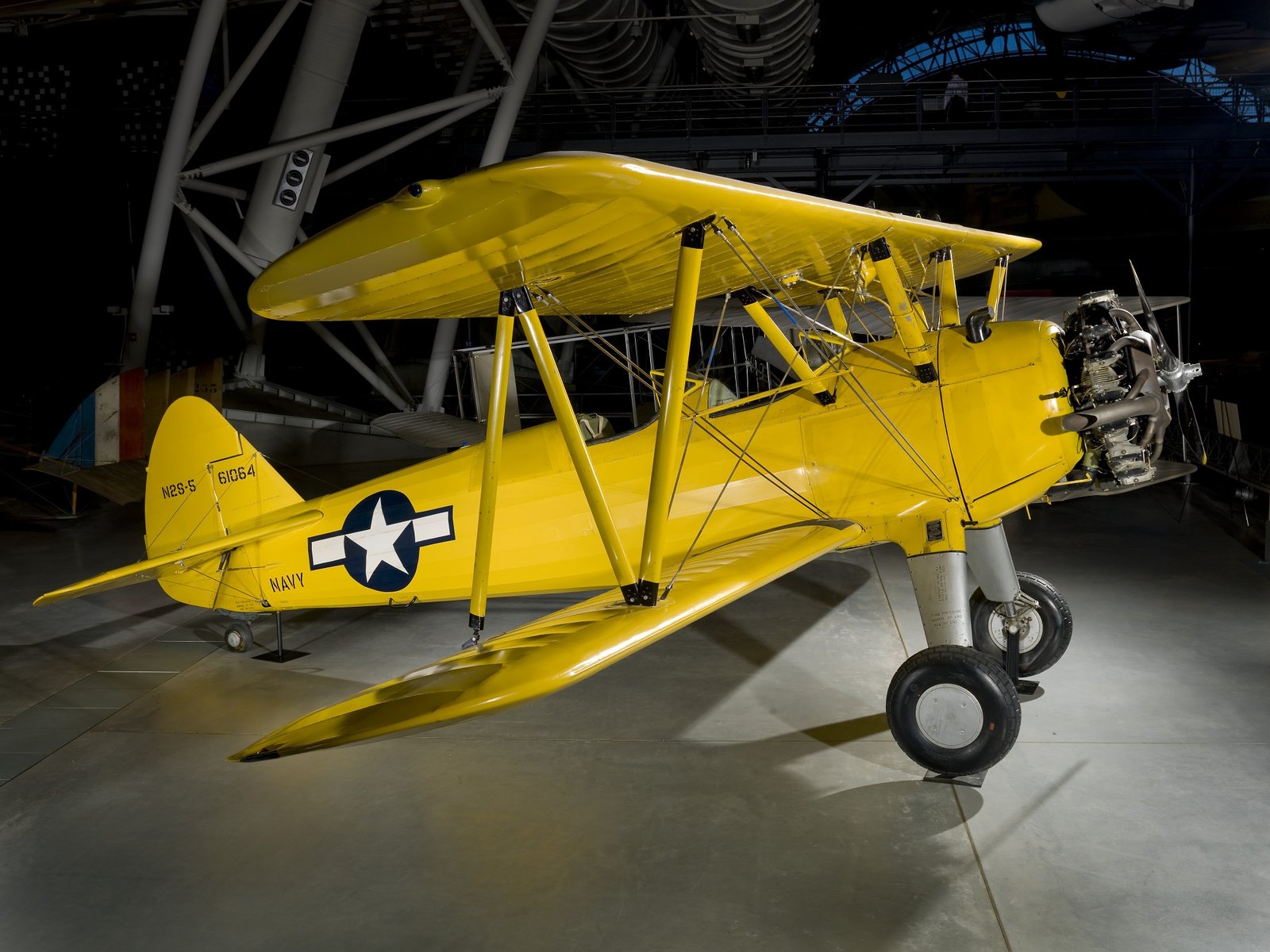
The U.S. Navy bought its own versions as the NS and N2S, with N2S-1 through N2S-5 models using Continental or Lycoming engines. Painted overall yellow, Navy primary trainers earned the nickname “Yellow Peril”.
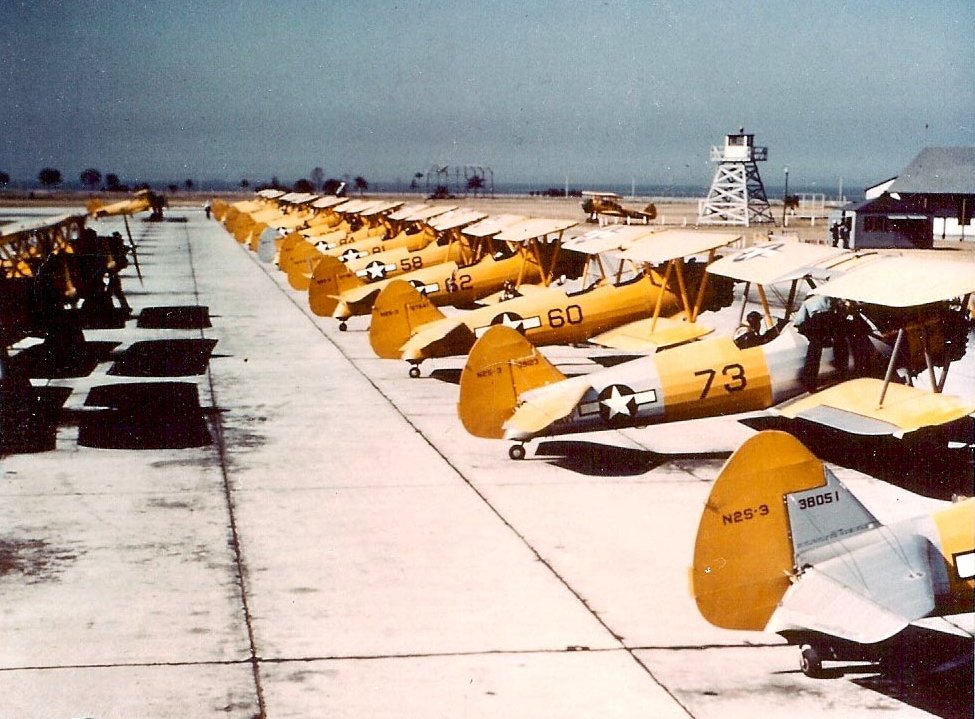
One neat detail: the Boeing-Stearman E75 was the only Army and Navy production design to be completely standardized during World War II. It served the Army as the PT-13D and the Navy as the N2S-5.
By the Numbers
A typical PT-17 had a wingspan of 32 ft 2 in (9.80 m) and a top speed of around 124 mph (200 km/h). The Smithsonian says Boeing’s Wichita Division built more than 10,000 Stearman trainers. Boeing’s own figure of 10,346 includes spare parts counted as aircraft, while one airframe count puts the number of complete Model 70s, 75s and 76s at 8,584. Whichever number you use, it’s one of the most-produced biplanes ever built.
The Backbone of WWII Primary Training
When the U.S. built up its air forces before and during World War II, it needed tens of thousands of new pilots, fast. Primary training meant a cadet’s first real flying, and the Stearman, along with Fairchild and Ryan trainers, became the backbone of Army and Navy primary training.
The Stearman suited the job. It was rugged, with a big, fixed tailwheel landing gear and tandem open cockpits for student and instructor. The National Naval Aviation Museum describes it as reliable, simple, durable and forgiving. Still, as a taildragger it demanded real attention on takeoff and landing, and that was exactly the kind of discipline future combat pilots needed.
Famous Cadets
- George H. W. Bush: In January 1943, Aviation Cadet George H. W. Bush made two flights in N2S-3 Bureau Number 05369 at Naval Air Station Minneapolis. That exact aircraft is now displayed at the National Naval Aviation Museum in Pensacola, Florida. Logbooks show five surviving N2S-3s that he flew in training.
- The Tuskegee Airmen: At Moton Field in Tuskegee, Alabama, African American cadets trained for Army Air Forces service. One of their PT-13D trainers, the Spirit of Tuskegee, now belongs to the Smithsonian’s National Museum of African American History and Culture in Washington, D.C. Its baggage compartment door is signed by 36 former Tuskegee Airmen.
A Second Career: Crop Dusters and Airshow Stars
After the war, thousands of surplus Stearmans were sold to civilians. Many became crop dusters. The front cockpit was replaced with a hopper for chemicals or fertilizer, and spray bars were fitted under the lower wings. A popular upgrade swapped in a more powerful Pratt & Whitney R-985 Wasp Junior engine. By one count, more than 4,345 Stearmans were working in agricultural flying in 1948. Even the Bush N2S at Pensacola spent part of its postwar life as a crop duster.
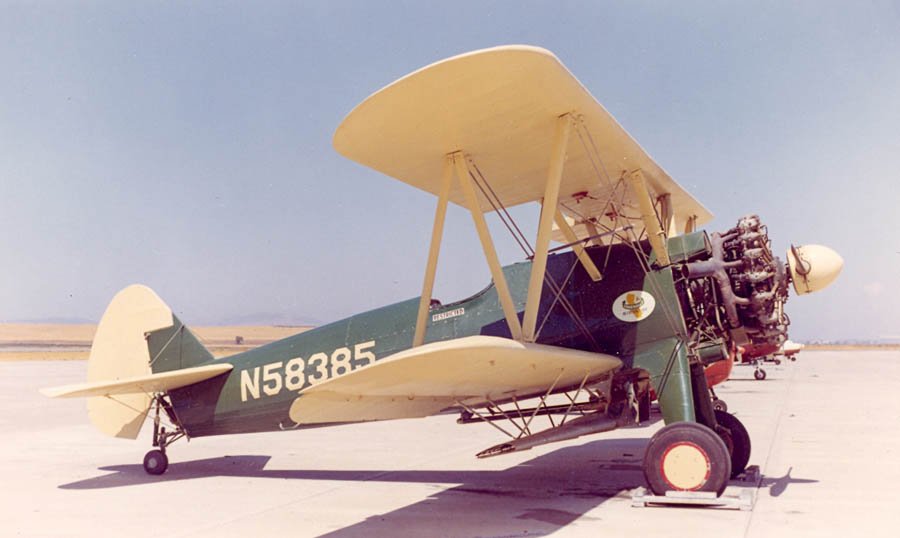
The Stearman’s strength and big, stable wings also made it a natural for air shows, aerobatics and wing walking. In the UK, the AeroSuperBatics wingwalking team flies a team of Boeing Stearmans fitted with 450-hp radial engines. Their wingwalkers perform strapped to the top wing.
Why Pilots and Fans Love the Stearman
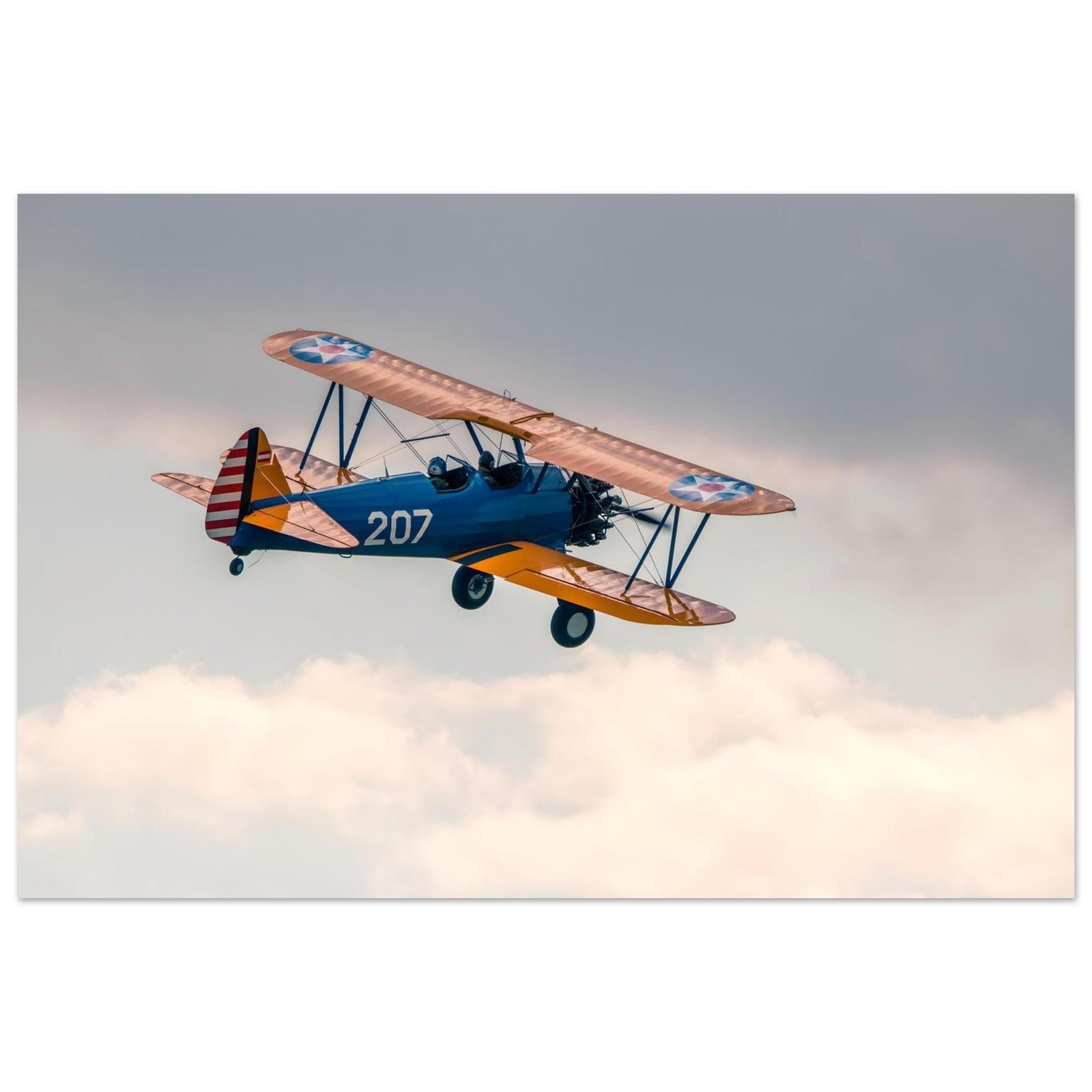
- It looks the part. Blue fuselage, yellow wings, star roundels, striped rudder. It’s the classic image of a biplane.
- That radial sound. An uncowled radial engine has a rumble you feel in your chest.
- It’s honest. Like the best trainers, it rewards good flying and lets you know when you’ve done it badly.
- It’s living history. Many surviving Stearmans trained real cadets who went on to serve.
That “old but still brilliant” spirit is exactly why we love our “I’m Not Old, I’m a Classic” biplane poster. It’s a fun nod to every proud vintage model out there, with or without wings.
And if you love the Stearman as much as we do, our Stearman Biplane in Flight print captures a blue and yellow Kaydet climbing above the clouds. It’s available as a printed poster or an instant digital download.
Where to See a Stearman in the U.S.
Museums
- Smithsonian’s Steven F. Udvar-Hazy Center, Chantilly, Virginia: An N2S-5 Kaydet, accepted by the Navy on December 7, 1943, is on display. It trained naval aviation cadets at NAS Ottumwa, Iowa, until 1946.
- National Naval Aviation Museum, Pensacola, Florida: The N2S-3 flown by Cadet George H. W. Bush.
- National Museum of African American History and Culture, Washington, D.C.: The PT-13D Spirit of Tuskegee.
The National Stearman Fly-In
Every September, Stearman owners gather in Galesburg, Illinois, for the National Stearman Fly-In. In 2026, the 55th event ran September 7–12 at Galesburg’s airport. It included formation flying, aerobatic and flour-bombing contests, and public community days. Check the official site for next year’s dates.
Where to Fly in a Stearman
Several operators offer open-cockpit Stearman rides. Each one below is listed on its own website:
- Military Aviation Museum, Virginia Beach, Virginia: Rides in a 1941 PT-17 from the museum’s grass runway, on weekends in season.
- Airplane Tours Virginia (Brown’s Biplane Rides): Flights from Warrenton Airport near Midland, Virginia, by appointment.
- Legacy Biplane Rides, Charlotte, North Carolina: A Boeing Stearman plus a WACO biplane.
- Flying Adventure, St. Petersburg, Florida: A 1941 Army Stearman flying from Albert Whitted Airport.
- Vintage Air Tours, near Corpus Christi, Texas: PT-17 rides on the Texas Gulf Coast. Check their site for current departure points.
Rides are usually one passenger at a time, and operators set their own age, weight and weather rules. Check each operator’s site for current details before you book.
Want more? Follow PlanesNStuff on YouTube for aviation Shorts.
Watch: The Biplane That Taught America to Fly
Thanks for Flying With Us
The Stearman taught a generation to fly, then went right on working, playing and inspiring. That’s quite a résumé for a biplane designed in the early 1930s.
God bless you with blue skies!
