Tag: drones

  • Best Beginner Drones in the US: What to Look For Under FAA Rules

    Best Beginner Drones in the US: What to Look For Under FAA Rules

    We haven’t tested these products ourselves. This roundup is based on manufacturer information, published specifications and owner reviews.

    So you want to fly a drone. Good choice! There’s nothing quite like watching your neighborhood, a favorite beach or a quiet stretch of farmland open up beneath you from a few hundred feet up. It’s also one of the easiest ways into aviation: you’re dealing with lift, wind, airspace and the same “see and avoid” thinking that real pilots use every day. (If you’ve ever wondered how those little propellers keep it all in the air, our post on how planes fly covers the basics of lift.)

    Before you buy, though, it pays to know the rules, because in the US the rules actually shape which drone makes the most sense for a beginner. Let’s start there, then look at the features that matter and three beginner-friendly drones worth a look.

    The FAA Rules for Fun Flyers, in Plain English

    If you’re flying purely for fun, the Federal Aviation Administration (FAA) treats you as a recreational flyer. If you fly for any kind of work or business, even a little, you need to follow the FAA’s Part 107 rules instead. The FAA’s own advice is simple: if you’re not sure, assume Part 107.

    Here are the recreational basics, straight from the FAA’s recreational flyers page:

    • Pass the TRUST test. The Recreational UAS Safety Test is free, online and run by FAA-approved test administrators (the Academy of Model Aeronautics, Embry-Riddle and Pilot Institute are among them). You can’t fail it, because wrong answers are corrected as you go. Save your certificate and carry proof when you fly, because the test providers don’t keep a copy for you. Details are on the FAA’s TRUST page.
    • Register if your drone weighs 250 grams (0.55 lb) or more. Registration is done online at FAADroneZone, costs a small fee, lasts three years and covers every drone you own as a recreational flyer. You must be at least 13, mark your registration number on the outside of the drone and carry your certificate. Drones under 250 g flown only for fun don’t need registering. See the FAA’s registration page.
    • Remote ID comes with registration. Since September 16, 2023, any drone that has to be registered must broadcast Remote ID, a kind of digital license plate. You can comply by flying a drone with Standard Remote ID built in, by fitting a broadcast module, or by flying only at an FAA-Recognized Identification Area (FRIA). More on the FAA’s Remote ID page.
    • Keep it in sight. You (or a visual observer standing right beside you) must be able to see the drone with your own eyes.
    • Give way to every other aircraft, always.
    • Stay at or below 400 feet (122 m) in uncontrolled (Class G) airspace.
    • Get authorization before flying in controlled airspace around many airports. Recreational flyers can request it through LAANC (the FAA’s automated approval system, available in several apps) or through FAADroneZone.
    • Follow a community-based organization’s safety guidelines, such as those of the Academy of Model Aeronautics (AMA).

    To check where you can fly, use an FAA-approved B4UFLY app. They show controlled airspace, temporary flight restrictions, national parks and more, and most also handle LAANC requests.

    One more thing that catches lots of new flyers: launching, landing or flying a drone from inside most national parks is prohibited, under a National Park Service policy dating back to 2014. Read the NPS’s explanation before you pack the drone for a road trip. State and local rules can add their own limits too.
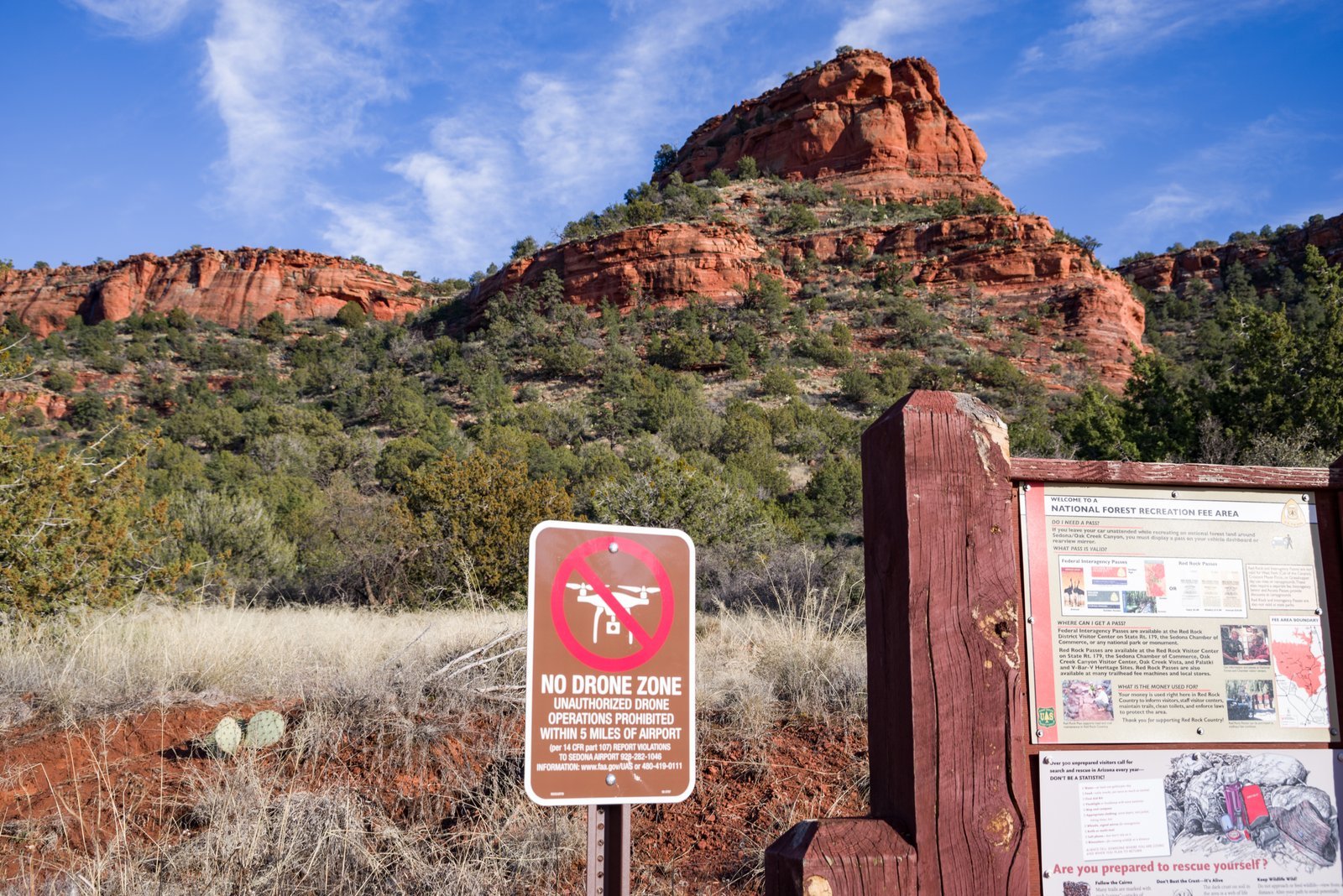
    A brown 'No Drone Zone' sign in front of red rock cliffs near Sedona, Arizona.
    A 2017 ‘No Drone Zone’ sign near Sedona’s airport in Arizona’s Coconino National Forest. Always check the current airspace before you fly. Photo: Coconino National Forest, public domain, via Wikimedia Commons.

    Why “Under 250 Grams” Is the Magic Number

    That 250 g line is why so many beginner drones are built to weigh just under it. Fly one for fun and you skip registration, and because you don’t have to register, you don’t need Remote ID either. You still need your TRUST certificate and you still follow every other rule above.

    A word of warning: some drones in this weight class can take an optional larger battery, and that can push the takeoff weight over 250 g. Once that happens, registration and Remote ID apply. Check the manufacturer’s specs for the exact battery you plan to use.

    What to Look For in Your First Drone

    • GPS position hold. A GPS drone holds its spot in the sky when you let go of the sticks, which makes learning far less stressful. Tiny indoor drones without GPS drift with every puff of air.
    • Return to home. If the signal drops or the battery runs low, a GPS drone can fly itself back to its takeoff point. It’s a beginner’s best friend, but check the return height before each flight so it clears nearby trees.
    • A stabilized camera. A 3-axis mechanical gimbal keeps video smooth and the horizon level. Single-axis gimbals with electronic stabilization work well too, though with less smoothing.
    • Wind resistance. Small, light drones get pushed around. Manufacturers often quote a “Level 5” rating (around 24 mph or 10.7 m/s), but a beginner should treat that as the limit, not the target.
    • Propeller guards. Handy for learning in a backyard or gym, and much kinder to fingers.
    • Spare batteries. Advertised flight times are measured in ideal, windless conditions, so real flights are shorter. Two or three batteries turn a quick hop into a proper afternoon of practice.
    • Beginner modes and one-tap takeoff. Slower speed modes, automatic takeoff and landing, and built-in tutorials help a lot in the first weeks.
    • Can you still buy it new (and get it serviced)? See the FCC note below.

    A Quick Note on the FCC Covered List

    In December 2025 the Federal Communications Commission (FCC) added foreign-made drones and key drone components to its Covered List. In practice, that means new foreign-made drone models can’t get the FCC equipment authorization they need to be sold in the US unless they receive a specific approval. Drones that were already authorized before then can still be sold, bought and flown legally, and owners can keep flying the drones they have. All three drones below were released and authorized before the change, but stock and accessories may get harder to find over time, so buy from an authorized retailer and check the FCC’s Covered List page if you want the latest.

    Three Beginner-Friendly Drones Worth a Look

    All three weigh under 250 g, so a purely recreational flyer in the US doesn’t need to register them. Specs below come from the manufacturers’ official pages.

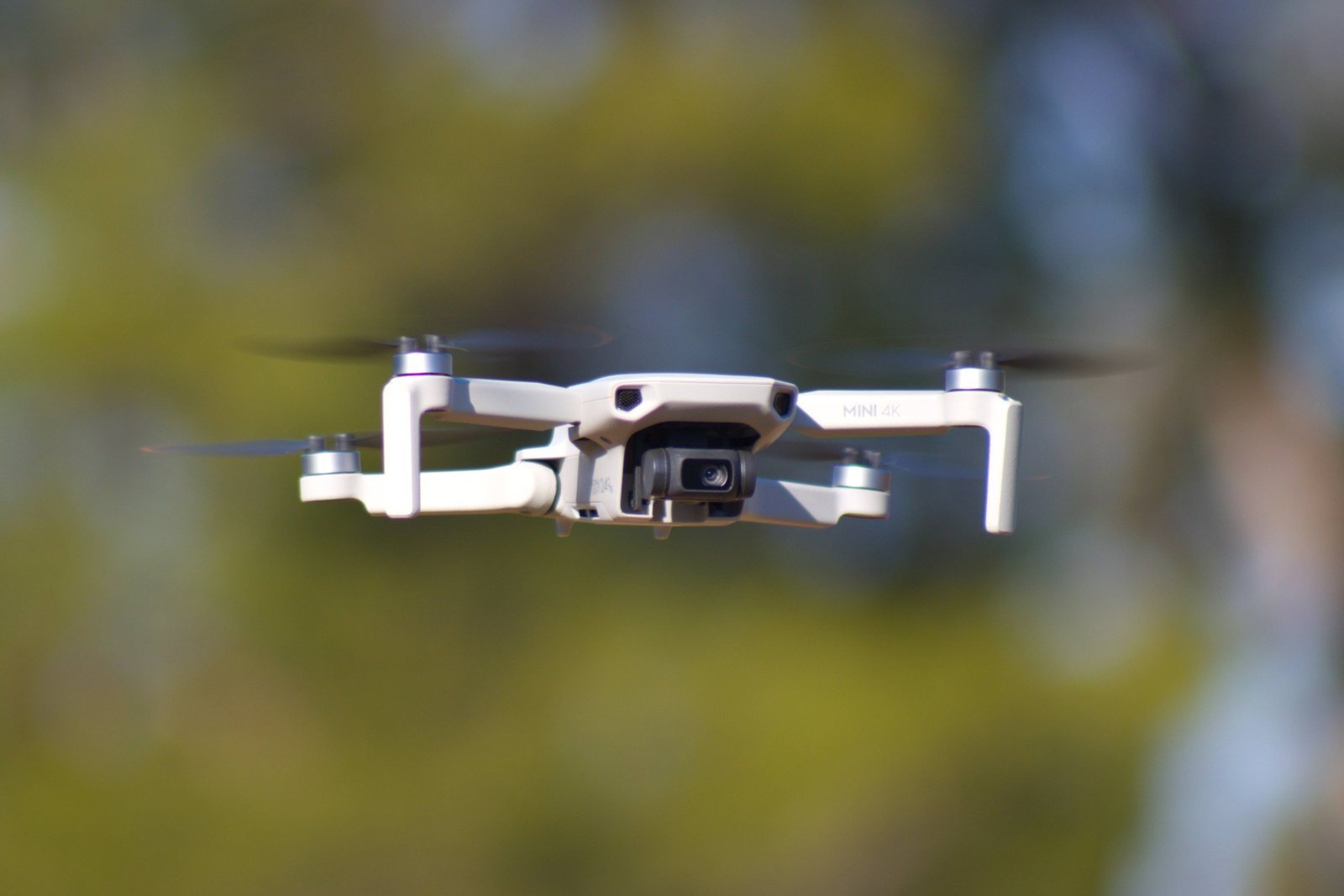
    1. DJI Mini 4K: The All-Rounder

    The DJI Mini 4K is DJI’s entry-level folding GPS drone, and it ticks almost every box on the list above.

    • Weight: 246 g (8.7 oz) standard takeoff weight
    • Flight time: up to 31 minutes (DJI’s figure, in ideal conditions)
    • Camera: 1/2.3-inch sensor, 4K video at 30fps, 4x digital zoom
    • Gimbal: 3-axis mechanical
    • Range: up to 10 km (6.2 miles) video transmission under FCC rules, though you must always keep it in sight
    • Wind resistance: Level 5 (10.7 m/s, about 24 mph)
    • Beginner help: one-tap takeoff and landing, return to home, and a beginner guide in the app

    Good for: someone who wants smooth travel and landscape video and a drone they won’t outgrow quickly. Keep in mind: it only has downward sensors, so there’s no obstacle avoidance. Fly in open spaces and keep your eyes on it.

    2. DJI Neo: The Tiny Selfie Flyer

    The DJI Neo is a very different beast: a palm-sized drone with enclosed propeller guards that can take off from and land on your hand, then follow you around for short clips.

    • Weight: about 135 g (4.8 oz)
    • Flight time: about 18 minutes (about 17 with the propeller guards fitted), per DJI
    • Camera: 1/2-inch sensor, 12 MP photos, 4K video at 30fps
    • Gimbal: single-axis mechanical (tilt), plus electronic stabilization
    • Range: about 50 m (164 ft) when flown from a phone over Wi-Fi, per DJI’s specs
    • Wind resistance: Level 4 (8 m/s, about 18 mph)
    • Sensing: downward positioning only

    Good for: first-timers, teens and anyone who mostly wants quick, fun clips of themselves on a walk, bike ride or at a family gathering. Keep in mind: the shorter range, lighter build and smaller wind rating mean it’s best on calm days and close to you.
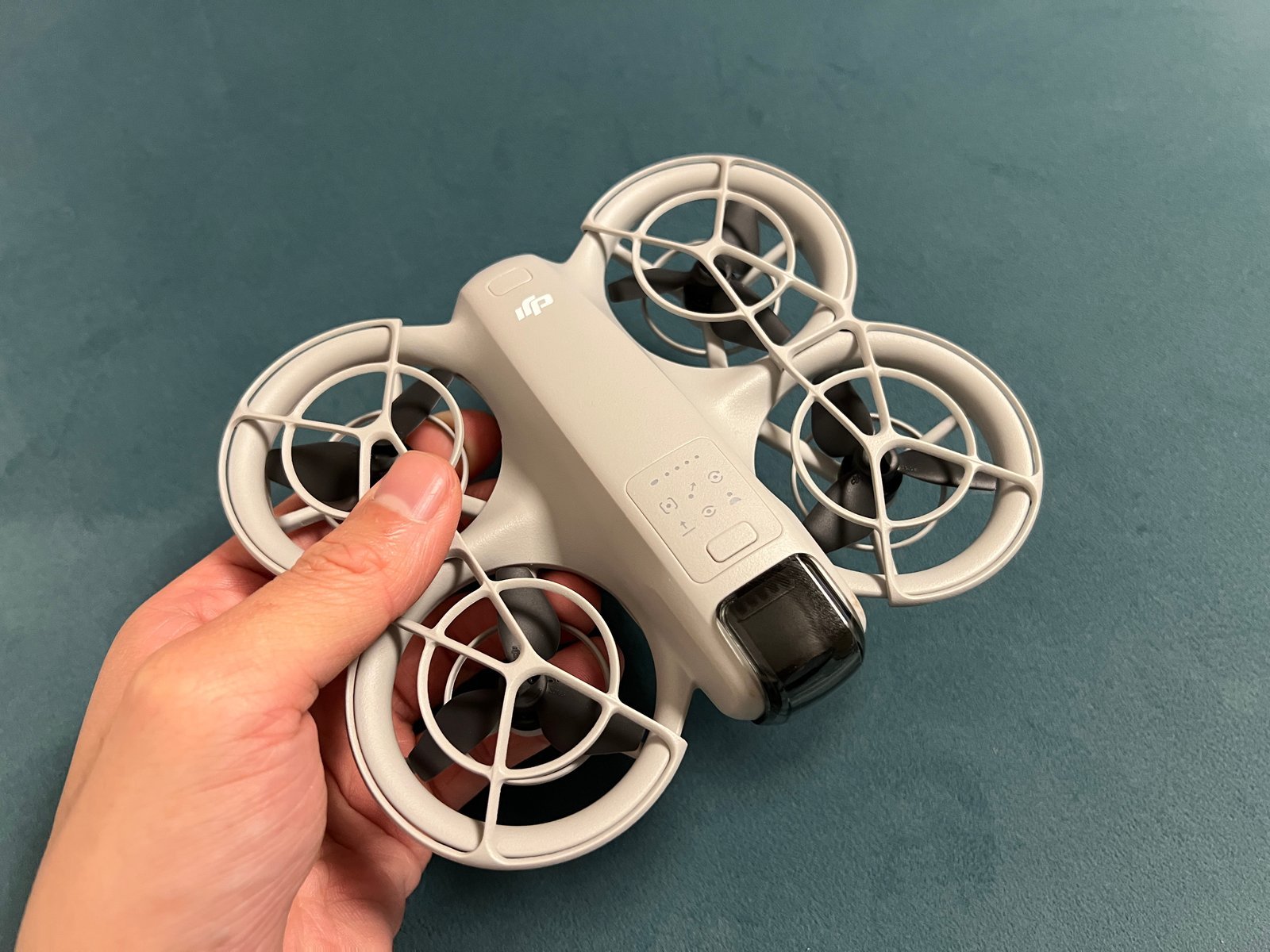
    A hand holding a small gray DJI Neo drone with round propeller guards.
    The palm-sized DJI Neo, with its built-in propeller guards. Photo: NAN LIU, CC BY-SA 2.0, via Wikimedia Commons.

    3. Potensic ATOM: The Non-DJI Alternative

    If you’d like an option from another brand, the Potensic ATOM is a folding GPS drone with a very similar recipe to the Mini 4K.

    • Weight: under 249 g (242 g per Potensic’s manual)
    • Flight time: up to 32 minutes (Potensic’s figure)
    • Camera: 1/3-inch Sony sensor, 12 MP photos, 4K video at 30fps
    • Gimbal: 3-axis mechanical
    • Range: up to 6 km (3.7 miles) with Potensic’s PixSync 3.0 transmission
    • Wind resistance: Level 5
    • Smart features: multi-system GNSS positioning, return to home, QuickShots and visual tracking

    Good for: beginners who want 3-axis smooth video, long flights and subject tracking from a non-DJI brand. Keep in mind: there’s no obstacle avoidance here either, and Potensic also sells a cheaper ATOM SE with a simpler single-axis gimbal, so check which model you’re looking at.

    Before Your First Flight

    1. Take the TRUST test and save the certificate on your phone.
    2. Practice in a big open field, well away from people, roads, trees and power lines, on a calm day.
    3. Check B4UFLY before every new location.
    4. Learn the controls slowly. Hover, then go forward and back, then gentle turns. Use beginner or slow mode.
    5. Set your return-to-home height above the tallest obstacle nearby.
    6. Consider joining a club. The Academy of Model Aeronautics has clubs and flying fields all over the country, and fellow flyers are the fastest way to learn.

    Thanks for Flying With Us

    A good first drone doesn’t need every bell and whistle. Something under 250 g with GPS, return to home and a stabilized camera will keep you legal, safe and smiling while you learn. Readers in Australia, our guide to the best beginner drones under CASA rules is coming soon. And if you’re shopping for someone else, our gift guide for aviation lovers has plenty more ideas, plus the vintage-aviation prints in our Art Shop.

    What was your first drone, or which one are you eyeing? Tell us in the comments.

    God bless you with blue skies!

  • How Do Planes Fly? Lift Explained Without the Math(s)

    How Do Planes Fly? Lift Explained Without the Math(s)

    Watch a fully loaded airliner lift off and it’s hard not to wonder: how do planes fly? You don’t need a single equation to understand it, and once it clicks you’ll see it everywhere, from paper planes and RC trainers to helicopter rotors and drone props.

    The Four Forces: Lift, Weight, Thrust and Drag

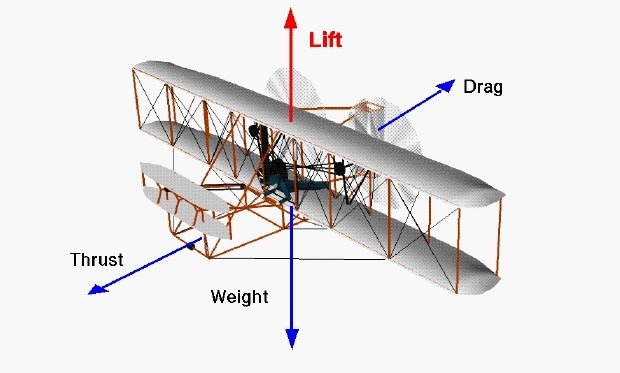
    Every aircraft in flight is pushed and pulled by four forces:

    • Lift holds it up. Most of it comes from the wings, and it acts at right angles to the flight path.
    • Weight is gravity pulling down on the aircraft, fuel, people and cargo. It drops as fuel is burned.
    • Thrust is the forward push from the propeller, jet engine or rotor.
    • Drag is the air resisting the aircraft’s motion.
    NASA diagram of the 1903 Wright Flyer biplane with arrows showing lift pointing up, weight pointing down, thrust pointing forward and drag pointing back
    The four forces acting on the 1903 Wright Flyer: lift, weight, thrust and drag. Image: NASA Glenn Research Center, public domain.

    In steady, level flight, lift balances weight and thrust balances drag. As the FAA’s Pilot’s Handbook of Aeronautical Knowledge points out, that doesn’t make all four equal: lift and weight are bigger than thrust and drag.

    Surprisingly, the engines don’t hold the plane up. As NASA puts it, the engine’s job is to overcome drag, and the wings do the lifting. Most gliders have no engine at all and fly just fine.

    So How Does a Wing Make Lift?

    NASA’s Glenn Research Center sums it up in one line: lift happens when a moving flow of air is turned by a solid object. A wing meeting the air at a slight angle turns the passing air downwards, and by Newton’s third law (every action has an equal and opposite reaction) the air pushes the wing up. Both the top and bottom surfaces help turn the flow.

    You can describe the same thing with pressure. The air speeds up over the top of a lifting wing, and faster-moving air has lower pressure. So the pressure on top ends up lower than underneath, and that difference, added up across the whole wing, is lift.

    Bernoulli or Newton? Yes.

    People have argued for years over whether lift is “really” Bernoulli (pressure difference) or “really” Newton (air pushed down). NASA’s answer: both are correct. They’re two ways of adding up the same flow, and they give the same force. Neither man ever tried to explain lift, by the way. Newton presented his laws of motion in 1686 and Bernoulli published Hydrodynamica in 1738, long before anyone flew.

    How much lift a wing makes depends on its shape and size, its angle to the air, the air’s density and, above all, speed. Lift grows with the square of speed. The FAA’s example: an aeroplane at 370 km/h (200 knots) has four times the lift it has at 185 km/h (100 knots), all else being equal.

    Busting the “Equal Transit Time” Myth

    You may have learned this at school: the top of a wing is longer, so air going over it must hurry to meet the air from underneath at the back edge. NASA Glenn calls it one of the most widely circulated incorrect explanations of lift:

    • Nothing makes the air meet up. Air over the top actually moves much faster than the theory says and reaches the trailing edge first.
    • The numbers don’t work. The theory’s speeds predict far less lift than real wings produce.
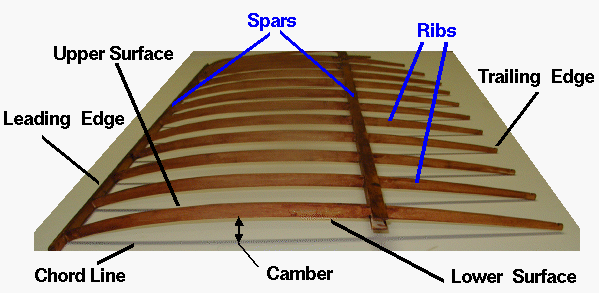
    • Equal-length wings fly. A paper plane’s wing is a flat sheet. The Wright brothers’ wings were thin curved plates, the same distance over the top and underneath.
    • Aeroplanes fly upside down. Flip the wing and the “longer path” is on the bottom, yet aerobatic pilots do it at airshows all the time.
    Uncovered Wright 1903 wing frame seen from the side, showing thin curved wooden ribs labelled with the leading edge, trailing edge, upper and lower surface, chord line, camber, spars and ribs
    The thin, curved ribs of a Wright 1903 wing, shown with the fabric removed. The distance over the top and underneath is the same, yet it makes plenty of lift. Image: NASA Glenn Research Center, public domain.

    The faster air and lower pressure on top are real; it’s the reason that was wrong. (We met the 1903 Flyer in our Golden Age of Biplanes post.)

    Angle of Attack: The Secret Ingredient

    Draw a straight line from the front edge of a wing to the back edge: that’s the chord line. The angle between it and the oncoming air is the angle of attack, the pilot’s main lever on lift.

    At small angles (up to about 10 degrees), NASA says lift rises almost in step with angle of attack. That’s why a pilot raises the nose just before lifting off the runway. It’s also why a slower aeroplane needs a higher angle of attack to make the same lift. A curved (cambered) aerofoil, or “airfoil” in US spelling, makes some lift even at zero angle. A symmetrical one needs tilting first.

    Stalls: When the Air Lets Go

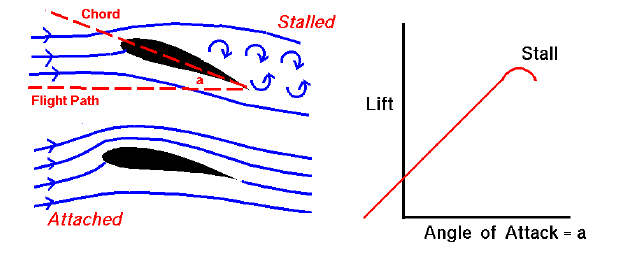
    Raise the angle too far and the air over the top can no longer follow the wing’s curve. It breaks away from the surface, and lift drops off sharply. That’s a stall.

    Diagram of two identical aerofoils: one at a small angle with smooth airflow hugging the surface, and one at a steep angle with the airflow breaking away into swirls, beside a graph of lift rising with angle of attack until it peaks at the stall
    Attached flow at a modest angle of attack (bottom) and a stalled wing at a steep angle (top). Lift climbs with angle until the stall. Image: NASA Glenn Research Center, public domain (cropped).
    • It’s not the engine. A stall is all about airflow over the wing.
    • It’s an angle, not a speed. The FAA says each aircraft stalls at one critical angle of attack, roughly 16 to 20 degrees depending on the design, whatever its speed or weight. So you can stall at any airspeed.
    • The fix is less angle. Most training aircraft are designed so the nose drops in a stall, which lowers the angle of attack and lets the air flow smoothly again.

    Flaps: Extra Lift for Slow Flying

    Fast cruising and slow landing want different wings, and flaps let one wing do both. Extended from the trailing edge, they increase lift (and drag) at any given angle of attack. The FAA lists four common types: plain, split, slotted and Fowler. Fowler flaps slide backwards on tracks before angling down, adding wing area as well as curve.

    View from a passenger window of a Boeing 737-800 wing with its double-slotted Fowler flap fully extended, sliding back and angling down before landing
    A fully extended double-slotted Fowler flap on a Boeing 737-800 before landing. Photo: AlexHe34, CC BY-SA 3.0, via Wikimedia Commons.

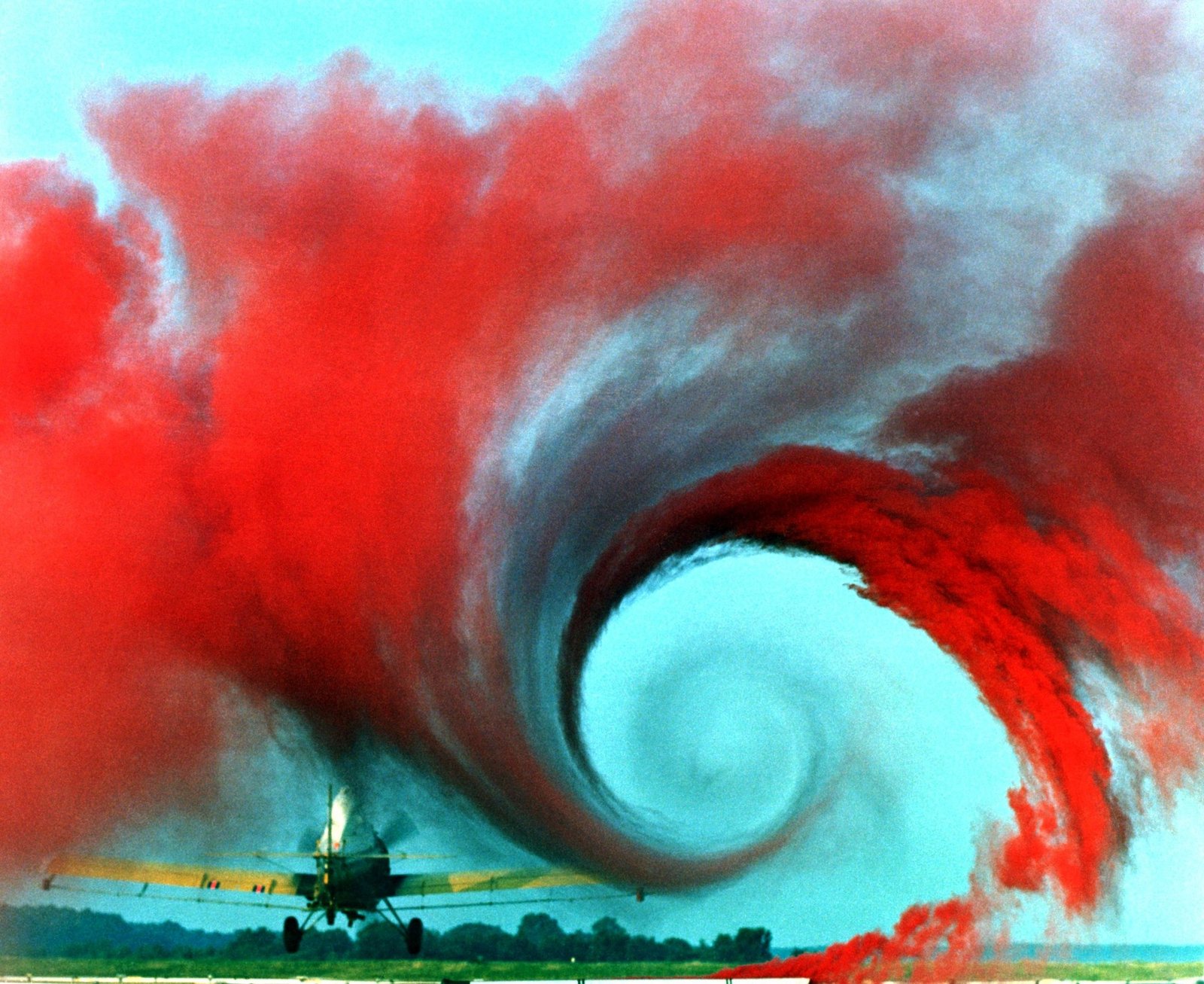
    The swirling smoke in our header photo shows another side effect of lift. Air spills from the high-pressure underside around each wingtip into the low pressure on top, rolling up into a wingtip vortex. The FAA says these are strongest when an aircraft is “heavy, clean, and slow”.

    Same Physics, Smaller Scale: RC Planes, Helicopters and Drones

    The FAA says the four forces act on all aircraft, backyard ones included.

    • RC planes: a foam trainer’s wing turns the air just like an airliner’s, and if you fly it too slowly with too much up-elevator, it will stall too.
    • Propellers: NASA describes a propeller as being like a rotating wing. Each blade has an aerofoil cross-section and is twisted, because the tip moves faster than the hub.
    • Helicopters: the rotor blades are spinning wings. Raising the collective increases the pitch of all the blades at once, and so their angle of attack. The spinning rotor also tries to turn the body the other way, which is why there’s a tail rotor.
    • Drones: NASA’s quadcopter guide explains that the props push air down and the reaction lifts the drone, which hovers when lift equals weight. Speeding up the props on one side tilts it so part of the lift pushes it sideways. Two props spin clockwise and two anticlockwise, so their twisting forces cancel.

    Try It Yourself

    • Paper plane: throw a simple dart gently and level, then nose-up. The nose-high throw slows, stalls and drops.
    • Hand out the window: only as a passenger, at low speed on a quiet road, with the driver’s OK and nothing nearby. Tilt the front of your flat hand up slightly and feel it rise. If in doubt, stick to the paper plane.
    • In your flight sim: in a light trainer, slow down gently in level flight with flaps up and note the speed when the stall warning sounds. Repeat with full flap and you should be able to fly slower. Lower the nose to recover.
    • NASA’s free simulator: the Student Airfoil Interactive lets you change angle, speed and wing shape and watch the lift change.

    Thanks for Flying With Us

    So, how do planes fly? The wing turns the air down, the pressure on top drops, and up you go. Angle of attack is the dial, a stall is turning it too far, and flaps add lift for landing. Same physics for an airliner, a Tiger Moth or a palm-sized drone.

    The Wright brothers’ wings were turning the air in 1903, and good design never goes out of style. That’s the whole idea behind our “I’m Not Old, I’m a Classic” biplane poster.

    Want more? Follow PlanesNStuff on YouTube for aviation Shorts. God bless you with blue skies!